
Destination
Shanghai 2026: River, Streets, Museums, 3 Days
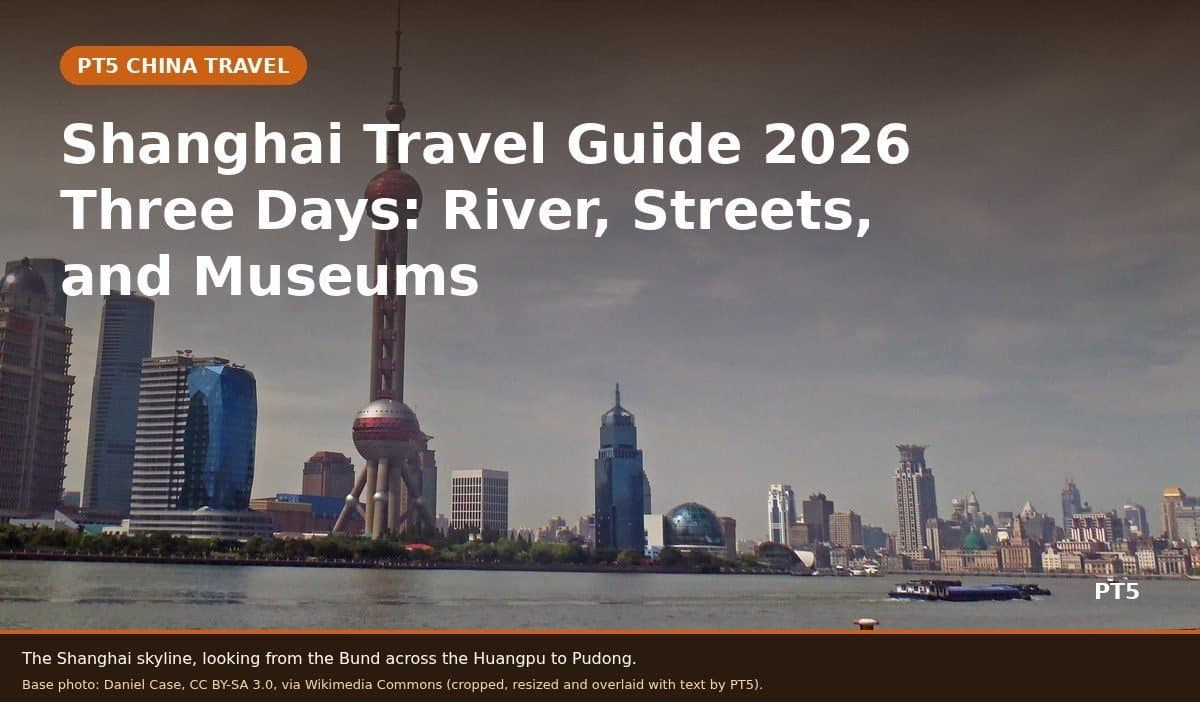
Summary: Shanghai is not a checklist; it is a line you walk. Start early at the river, spend the afternoon on the streets, hand the rainy hours to the museums, and keep one meal and one walking afternoon for yourself. This guide gives you a three-day order, where to base yourself, how the metro and ferries work, and the rules that catch visitors out.
The decisions come before the sights
Shanghai is the one city on this route you do not have to plan a month ahead. What decides your three days is not whether you scored a reservation, but three things: what time you leave, which streets you walk, and which side of the river you sleep on.

Five numbers that shape a Shanghai trip
| Item | Number |
|---|---|
| Days needed | Three full days minimum: one for the river, one for the streets, one for the museums |
| Book before you fly | Barely. The Shanghai Museum East Wing’s permanent galleries need no booking; Yu Garden sells on site or on its official mini-program. Only the Yu Garden night tour, the Shanghai Tower deck and Pudong Museum specials really want a purchase ahead |
| Yu Garden ticket | ¥40 (about US$6) peak, April to June and September to November; ¥30 (about US$4.5) off-peak[3] |
| Metro fare | From ¥3 for the first 6 km, then ¥1 per 10 km; Maglev ¥50 (about US$7.5) one way, ¥80 (about US$12) return[6] |
| Cheapest river crossing | The Huangpu ferry, ¥2 per pedestrian[5] |
1. Why Shanghai, and who should skip it
Shanghai is one of the easiest big cities in China to walk. It has no gate you queue three hours for. Instead it offers a mesh: streets lined with plane trees, two riverbanks, and a metro network of more than 21 lines and over 900 kilometres[8]. You step out, walk two blocks, ride four stops, cross one river, and the day works, with almost nothing locked a month ahead.
Come to Shanghai to watch one city turn old and new at once on two banks of one river, if you like walking and stopping for a drink, and if gates and timetables put you off. Think about reordering your trip if you only want to photograph the three most famous sights, or if a park having a closing time wears you down. Shanghai has no wall to stop you. It has the closing days of its venues, and the schedule of the river lights.
Beside Beijing the division of labor is clear: Beijing forces you to plan ahead, Shanghai rewards improvisation. So this post is not about winning a ticket. It is about one thing: which street, at what hour, is emptiest.

No-repeat rule: payments, connectivity, hotel types, general scams, high-speed rail, seasons and crowd patterns, and dish-by-dish pricing are referenced, not rewritten here. The linked posts carry the full versions.
2. What you actually need before you fly
The biggest difference from Beijing: Shanghai has no book-first-or-stay-out gate. Most venues are free, most districts are free, and the metro and ferry run whenever you turn up. Before you fly you do not win a ticket; you understand four things and leave the rest to the day.
1. Free, but check the closing day
- Shanghai Museum, East Wing: 1952 Century Avenue, Pudong. 10:00–18:00, last entry 17:00. The permanent galleries need no booking; closed Tuesdays except public holidays[2].
- Shanghai Museum, People’s Square: 201 Renmin Avenue, Huangpu. 09:00–17:00, last entry 15:00, closed Mondays except public holidays. It currently hosts the Americas exhibition, so visits need a paid ticket during that run[1].
- Worth noting: the two branches close on different days, one Monday, one Tuesday. Checking the weekday matters more here than chasing a ticket.
2. The four things that do want a ticket
- Yu Garden: daytime tickets come from the on-site window or the official Shanghai Yu Garden mini-program, at ¥40 in peak months (April–June, September–November) and ¥30 off-peak (July–August, December–March)[3]. The evening is separate, below.
- Yu Garden night tour: sold by session, roughly ¥188 (about US$28) on Tuesdays and Wednesdays and ¥218 (about US$33) from Friday to Sunday and on public holidays, with English sessions priced higher[4]. If you want the garden at night, this is the only way in.
- Shanghai Tower observation deck (118F): real-name ticketing with timed entry, 08:30–22:00, last entry 21:30. Adult tickets run about ¥180 (about US$27), and passports work for foreign visitors[7].
- Museum of Art Pudong: one ticket covers all current exhibitions, from ¥80. A few special projects need a separate timed slot on their own mini-program.
One line to remember: for the free ones, check the closing day; for the paid ones, check the session. Only night sessions and the observation deck really want locking in advance. Everything else can be decided on the day.

3. The three days that work
The three days follow one rule: put whatever you want crowd-free in the morning, and leave the flexible half for the least reliable weather day. Shanghai’s crowds can be dodged by the clock: the Bund before 08:00 and after 20:00 are two different places.

Day 2 · The streets
Start late. At 15:00 leave from Wukang Mansion, walk Wukang Road, turn onto Anfu Road, stop for coffee on Wuyuan Road, and finish at Fuxing Park or straight into dinner. For a crowd, head to Xintiandi or Tianzifang afterwards.
Day 3 · The museums
Morning at Shanghai Museum East Wing (free, closed Tuesdays), afternoon at Jing’an Temple and Nanjing West Road, late afternoon at the north Bund, and the evening kept as a backup slot for the tower.
Four places that need their own half-day
Zhujiajiao, Disney, the West Bund art district and the Natural History Museum all sit off this route. Forcing them into three days turns the trip into a race. Add a day, or swap one for the Day 3 museum block.
4. Where to stay
Choosing a district is really choosing how you get home at night. The metro strings the sights together anyway, so you can see them all from anywhere. The difference is your walking radius and how quiet the evening feels.
The former French Concession (Jing’an / Xuhui)
For walking out of your door into plane trees and strolling to dinner. Shanghai is easiest to settle into here, at the cost of a few more metro stops to the Bund and Lujiazui.
Lujiazui
For skyline views and taking children up the Shanghai Tower deck. Evenings are very quiet, malls shut on time, and convenience stores are sparser than in the old city.
Jing’an Temple / Nanjing West Road
The most convenient base for shopping and transfers, with Lines 2, 7 and 14 meeting at Jing’an Temple station. Lively by day and far from dead at night, good if your days are packed.
Hongqiao hub
Only for the night before or after an early flight or train. Thirty minutes or more into the center; not workable if you sightsee that day.
Two hard reminders
Hotels inside old lanes often cannot be reached by car at the door. And a river-view room and a room that can see the river may be separated by a road. Check the address and real photos before booking.

5. Getting around: metro, ferry, airports
In Shanghai the metro is not the cheap option, it is the quick option, and it spans more than 900 kilometres across 21 lines. The underrated one is the ferry: ¥2 turns a traffic-blocked crossing into a ten-minute ride on the water.
The metro and its fares
- Urban lines are distance-based: ¥3 for the first 6 km, then ¥1 per further 10 km[6]. The Airport Link Line between Pudong and Hongqiao starts at ¥4.
- Main interchanges: People’s Square (1/2/8), Century Avenue (2/4/6/9), Nanjing West Road (2/12/13), Longyang Road (2/7/16/18 plus the Maglev) and Xujiahui (1/9/11)[8].
- Getting through the gates: contactless cards such as Visa, Mastercard, Amex, JCB and UnionPay tap straight through[5]. The Shanghai Metro app and station single tickets also work.
Ferry or sightseeing cruise
- The ferry (recommended): ¥2 per pedestrian, ¥2.8 with a bicycle or e-bike[5]. The East Jinling Road pier is the closest to the Bund, crossing to the Dongchang Road side. A commuter boat for locals, and the best-value river view a visitor can buy.
- The sightseeing cruise (a different thing): a tourism product, the daytime classic sailing listed around ¥120 (about US$18) and the express around ¥100, evening trips more[9]. Choose it to watch the two banks at leisure, not just to get across.
Two airports
- Airport Link Line: connects Pudong and Hongqiao airports from ¥4, and is the fastest rail link between the two[5].
- Maglev: Pudong Airport to Longyang Road, roughly 30 km in about 8 minutes at up to 300 km/h, ¥50 one way and ¥80 return[5]. It only takes you to a metro interchange, not to your hotel door.
Taxis: a standard cab starts at ¥14 (about US$2.1) for the first 3 km, then about ¥2.7 per km[5]. In peak hours the metro is usually quicker. For payments and cash, see our payments post.

6. One afternoon on foot: Wukang Road to Anfu Road
If Shanghai gives you only one afternoon on foot, give the best three hours of your three days to this stretch. The former French Concession has no ticket, no gate and no single headline sight. It is a walkable district: a ship-shaped apartment block from 1924, two rows of century-old plane trees, and the densest run of cafés in the city. Your job is not to tick boxes but to be on this street at the right hour.
The timing first: leave at 15:00, not at noon, and not on a weekend. Wukang Mansion at midday on a Saturday is the most crowded photo spot in the city. The only way to shoot it empty is early morning, 07:00 to 09:00.
The route runs about 3 kilometres, or two and a half to three hours with stops. Start at Wukang Mansion (Wukang Road at Huaihai Middle Road). End at Fuxing Park or over dinner.


Walk it by the clock: 15:00 photograph the ship-like prow of Wukang Mansion; 15:20 head north along Wukang Road past 1920s and 1930s houses and bookshops; 16:10 turn onto Anfu Road, the densest stretch of restaurants and design boutiques; 16:50 stop for a drink on Wuyuan Road; 17:20 optionally Fuxing Park, a rare French-laid-out garden, free, closing at 18:00; after 18:00, dinner around Anfu Road. To link it to Tianzifang, take Line 1 one stop from Changshu Road to South Shaanxi Road and walk south.
Do not: drive into this district (few spaces, many one-way streets), come at midday on a weekend for the mansion shot, or step into the road for a better angle.
7. What to eat, and where
This section answers one question only: which district, which meal. Cuisines and price ranges are covered in our food post.
- Soup dumplings · the old city and the Yu Garden quarter. Order the classic pork; bite a small opening first to let the broth out, do not take one whole.
- Pan-fried buns · neighbourhood breakfast stalls. Crisp-bottomed, four to a portion, with a bowl of savoury soy milk. More everyday and cheaper than soup dumplings, and best eaten in the morning.
- Shanghai home-style cooking · the French Concession and the old city. Braised pork belly, eel in hot oil, flash-fried shrimp: a proper sit-down meal, and the right dinner after the Wukang Road walk.
- Breakfast · any lane entrance. Sticky-rice rolls, flatbread with fried dough, savoury soy milk, done in twenty minutes. On a morning you leave early for an empty Bund, this is the meal.

8. Fabric, tailoring and a suit that fits
Shanghai is where visitors have clothes made. The South Bund Fabric Market, at 399 Lujiabang Road, is the default: 285 tailoring shops under one roof, open 09:00 to 18:00, a short walk from Metro Line 4 Nanpu Bridge. It grew out of the Dongjiadu cloth market that the whole neighbourhood was built around, and it still works the same way, selling cloth by the metre and taking orders for suits, shirts, overcoats, evening gowns, qipao and Tang-style jackets.
What it costs and how long it takes. A made-to-measure suit typically runs 2,000 to 4,000 yuan, about US$300 to US$600, roughly a third of a comparable bespoke price in Europe or North America. Production is usually six or seven days, and express shops promise two. The spread comes from the cloth, the lining and the handwork, so ask what is inside the jacket before you compare two quotes.
Bargain, every time. The first number is an opening, not a price: the same bolt of cloth is quoted differently two doors apart, so price two or three shops and come back to the one you liked. Expect to land well under the opening ask, and never pay a deposit before you have walked the floor.
Check the same item on 1688 before you negotiate. The Chinese wholesale platform lists the same fabrics and ready-made garments, often at a fraction of the quote, so a two-minute search tells you where the floor is. Tailoring is worth paying for when you need the fit, the cloth or the handwork; if you only want a standard cut, buying ready-made and having it altered at home can be cheaper.
The order, in order. Cloth and style first, then measurements, a dozen numbers taken once, then a deposit of about half. Insist on a fitting on the half-finished garment before the final stitch, and ask for a written slip with the cloth, the lining, the collection date and the number of free alterations. Pay the balance on collection, and look the garment over in daylight before you accept it.
Language, post and small print. Most shops speak enough English to work from a photograph or a garment you brought, and several keep their own WeChat contact for follow-up orders. A postal desk inside the market ships finished garments to more than 170 countries, so a suit can follow you home. Leave a week before your flight rather than a day, keep the receipt for exchanges, and treat the tourist touts at the door as a sign to walk one block further.


9. Two hours off the tourist track
Shanghai is two cities: one before 08:00 and one after 21:00. These three places need no booking and no ticket, and each has an hour that suits it.
- The Suzhou Creek banks · 07:00–09:00. From Waibaidu Bridge westwards, a riverside path, old warehouses and bridge after bridge, with almost no visitors, mostly joggers and dog walkers.
- North Bund · late afternoon. Looking across to Lujiazui, the view is fuller than from the Bund and the crowd a level smaller. From there, walk on to Waibaidu Bridge as evening sets in.
- Fuxing Park · 06:30–09:00. A rare French-laid-out park, free to enter. Local tai chi and dance groups come out early; by afternoon just a quiet green space.

10. Rules that catch visitors out
- Venues close, and on different days: the Shanghai Museum People’s Square branch on Mondays, the East Wing on Tuesdays[1][2]. Check the weekday before planning a museum day.
- The Bund has two densities. Shoot it empty by getting up early, or see the lights by accepting the crowd. You do not get both.
- A Yu Garden ticket and the Yu Garden night tour are two products. The daytime ¥40/¥30 ticket is not the evening show, which is sold separately by session[4].
- The ferry is not the cruise. Crossing is ¥2, sightseeing starts at ¥100[5][9]. A ferry ride is not a tour boat.
- Mobile payment is the default, cash the fallback. Small shops, ferry gates and station machines mostly expect a scan. Carry a bank card or a little cash (see our payments post).
- Weather decides the waterfront plan. Plum rains, midsummer afternoons and typhoon season change how the Bund and any long walk feel. Keep an indoor venue as a fallback (see our best-time-to-visit post).
11. FAQ
Can I do Shanghai without speaking Chinese?
Yes, and more easily than in Beijing. Metro signs are bilingual, contactless bank cards tap straight through the gates, and the main commercial areas carry plenty of English signage. Two friction points remain: the mini-programs used to order food and buy tickets, and telling a taxi driver where to go. Sort the first on your hotel wifi, and keep destinations saved as Chinese screenshots for the second.
Which museum closes on which day?
The two Shanghai Museum branches close on different days: People’s Square on Mondays and the East Wing on Tuesdays, both except public holidays. The East Wing’s permanent galleries are free, while the People’s Square branch charges during its current Americas exhibition[1][2].
Do the two Shanghai airports connect by rail?
Yes. The Airport Link Line runs between Pudong and Hongqiao airports from ¥4 and is the fastest rail link between them[5]. The Maglev is a separate line: Pudong Airport to Longyang Road in about eight minutes at up to 300 km/h, at ¥50 (about US$7.5) one way and ¥80 (about US$12) return, and it drops you at a metro interchange rather than at a hotel door[5].
Where PT5 Fits In
Shanghai is not hard. The details are: which exit to take, which street at which hour, what is on the table you just ordered. Having someone on the ground is the most effortless help this city can give.
Someone on call all trip
A walking companion for the street afternoons, help booking venues and restaurants, a three-day plan mapped to your dates, and a fast reply whenever something goes wrong.
Data and payments ready first
Connectivity and payment set up before you land, so day one is not spent on a breakfast you cannot pay for.
Quoted in writing, and no tips
Every job is quoted in writing before we start, so the number you agree is the number you pay. Our agents do not accept tips.
Two boundaries, stated plainly
We do not promise safety. We translate, advance small amounts, and accompany you to a police station, hospital or embassy. We do not make police, medical or legal judgments.
If you want those three days handled, start in the trip group and we will map it against your dates.
The Short Version
Shanghai is not a city you see and leave. It is a line you walk. Leave early for the river, spend the afternoon on the streets, hand the rainy day to the museums, and keep one meal and one afternoon walk for yourself.
Onward from Shanghai
- High-speed rail from Shanghai Hongqiao to Guangzhou South takes about 6 hours 20 minutes at best, with most services running 6.5 to 7.5 hours.
- Second class commonly runs from about ¥790 to ¥950 (about US$118–142); check live 12306 fares in the week you travel[10].
- Ticketing, seat choice and transfer buffers are covered in our high-speed rail post.

Sources
[1] Shanghai Museum, opening hours and visiting notice – shanghaimuseum.net – read 2026-09-19.
[2] Shanghai Museum, official site – shanghaimuseum.net – read 2026-09-19.
[3] Yu Garden, official site and visitor notice – yugarden.com.cn – read 2026-09-19.
[4] Shanghai Culture and Tourism Bureau, Yu Garden night tour hours – whlyj.sh.gov.cn – read 2026-09-19.
[5] Shanghai Municipal Government (English portal), public transport and fares – english.shanghai.gov.cn – read 2026-09-19.
[6] Shanghai Municipal Government, metro fare reform consultation – shanghai.gov.cn – read 2026-09-19.
[7] Shanghai Tower, observation deck ticketing notice – shzxds.com – read 2026-09-19.
[8] Shanghai Metro, official lines and fares – shmetro.com – read 2026-09-19.
[9] Jiefang Daily / Shangguan, 2026 Shanghai Tourism Festival ticket list (Yu Garden night tour and Huangpu cruise list prices) – jfdaily.com – read 2026-09-19.
[10] China Railway 12306, fares and timetables – 12306.cn – read 2026-09-19.
 Chat on WhatsApp
Conversation
Comments are closed for this guide.