Food
Chinese Food Guide for Foreigners: What to Eat in China
Chinese food is many cuisines, not one, and this guide walks a first-time visitor through the eight great cuisines, the dishes worth planning a trip around, how to order with QR menus and the pointing method, vegetarian and halal options, street-food safety and the etiquette of the table.
“Chinese food” is not one cuisine, and once you land in China that becomes obvious within your first meal [1][4]. What you eat in Chengdu has almost nothing in common with what you eat in Guangzhou, and a Beijing breakfast looks nothing like a Shanghai one [4]. Food is one of the greatest reasons to travel in China, and also one of the areas where visitors worry most: can I order without speaking Chinese, will it be too spicy, what if I am vegetarian, is street food safe [2][3]. This guide answers all of it in plain English, so you can spend your trip eating well instead of worrying.
In 2026 the practical reality is better than you expect: most city restaurants use QR-code menus with photos, so you can order from your phone with almost no Chinese [2][3]. Delivery apps bring restaurant food to your hotel in 20-40 minutes [3]. And the food itself, from a ¥12 noodle bowl to a ¥298 Peking duck, is routinely excellent value [3][5]. Here is everything you need: the eight great cuisines, the dishes you should not miss, how to order, how to handle special diets, how to eat street food safely, how the table works, and the phrases that fix almost any dining moment.

Quick facts first
- China’s cooking is grouped into the Eight Great Cuisines (ba da cai xi): Sichuan, Cantonese, Shandong, Jiangsu, Zhejiang, Fujian, Hunan and Anhui, each with its own flavor profile and signature dishes [4][5].
- The two extremes most travelers meet first are Sichuan and Cantonese: numbing-spicy versus light and fresh, and almost everything else sits between them [4][5].
- You can order without speaking Chinese. In city restaurants, a QR-code menu with photos is the normal way to order; scan with WeChat or Alipay, tap dishes, pay in the app [2][3].
- Food is cheap by international standards: a local noodle bowl runs ¥12-25 (about US$1.8-3.7), a mid-range dinner ¥60-150 per person, and street snacks ¥5-20 [3][5].
- Street food is generally safe if you choose stalls the way locals do: eat where there is a queue and high turnover, watch food cooked to order, and drink bottled water [2].
- Vegetarianism needs active communication. Many “vegetable” dishes contain oyster sauce, lard or meat stock; the working phrase is “wo chi su” (I eat vegetarian) plus the full list of things to exclude [2].
- Cash is almost dead in food settings. Mobile payment is accepted almost everywhere; many QR ordering systems actually require mobile payment to complete the order [3].
- Tap water is not potable in China. Drink bottled or boiled water, and stick to peelable fruit unless you can wash it [2].
- Spice levels are negotiable. “Bu la” (not spicy) and “wei la” (mild) work at most restaurants; for hot pot, order the “yuanyang” split pot, half spicy and half mild [4][5].
- The bill is called “maidan.” You ask for it, then pay at the counter or scan; tipping is not expected at ordinary restaurants [1][5].
1. The Eight Great Cuisines
The “Eight Great Cuisines” framework dates back to the Qing dynasty and reflects geography: coastal regions lean on seafood and light cooking, inland and mountainous areas developed bolder, spicier flavors because fresh ingredients were harder to keep [4]. Roughly speaking, the north eats wheat (noodles, dumplings, buns) with salty and hearty flavors; the south eats rice with fresher, sometimes sweeter cooking; the west and southwest are the spice capitals; and the east favors sweeter, soy-forward braises with refined presentation [4][5].
| Cuisine | Flavor profile | Signature dishes |
|---|---|---|
| Sichuan (Chuan) | Numbing and spicy (mala), bold and layered | Mapo tofu, kung pao chicken, hot pot, dan dan noodles |
| Cantonese (Yue) | Light, fresh, ingredient-driven | Dim sum, char siu, white cut chicken, roast goose, steamed fish |
| Shandong (Lu) | Salty, savory, crispy, umami-rich | Sweet and sour carp, braised sea cucumber, Dezhou chicken |
| Jiangsu (Su) | Refined, mildly sweet, elegant | Squirrel mandarin fish, lion’s head meatballs, salted duck |
| Zhejiang (Zhe) | Mellow, fresh, lightly sweet | Dongpo pork, West Lake fish in vinegar, Longjing shrimp |
| Fujian (Min) | Umami, seafood, soup-heavy | Buddha jumps over the wall, oyster omelet, fish balls |
| Hunan (Xiang) | Dry, fiery heat without numbing | Steamed fish head with chopped chilies, Mao’s red-braised pork |
| Anhui (Hui) | Earthy, hearty, often preserved | Stinky mandarin fish, braised wild vegetables, smoked meats |
Two cuisines matter most for first-time visitors. Sichuan is the cuisine most foreigners picture when they think “spicy Chinese food,” and the reputation is earned: its signature is mala, the combination of chili heat and the tingling numbness of Sichuan peppercorns, and it is not just hot, it makes your lips buzz [4][5][6]. The benchmark dishes are mapo tofu, kung pao chicken, hot pot and dan dan noodles [4][6]. Cantonese, the polar opposite, is the cuisine that traveled the world: the philosophy is to preserve the natural flavor of fresh ingredients with light seasoning, steaming and quick stir-fries, and the dim sum morning-tea ritual (yum cha) is one of the great eating experiences in China [4][5][6]. If you only remember two names, those are the extremes; everything else sits in between [4].

2. Must-try dishes across China
Beyond the cuisines, these are the dishes that define a first visit to China [1][2][3][4]. None of them are optional for a serious eater:
Peking duck (Beijing kao ya). The signature Beijing dish: crispy-skinned roast duck carved at your table, wrapped in thin pancakes with scallion and hoisin sauce. At a specialty restaurant expect ¥128-298; even a mid-range version is a memorable meal [2][3].
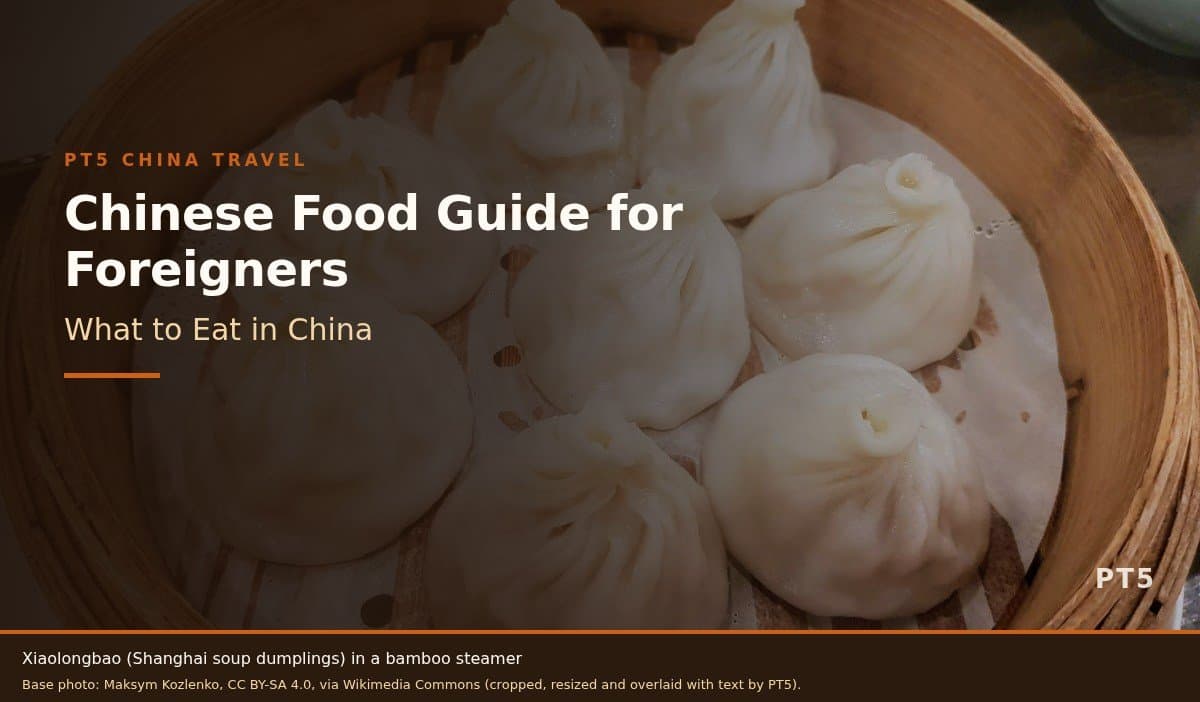
Xiaolongbao (xiao long bao). Shanghai’s soup dumplings: thin-skinned buns holding hot broth and pork. Bite a small hole, slurp the soup, then eat the dumpling. ¥28-68 a basket at well-known places, less at neighborhood spots [2][3].
Hot pot (huo guo). The great communal meal of Sichuan and Chongqing: a bubbling pot of chili broth at your table where you cook raw meat, vegetables and tofu yourself. Order the “yuanyang” split pot, half spicy and half mild, and use the sesame-oil dipping sauce to cool the spice. ¥80-180 per person [2][3][5].
Mapo tofu (ma po dou fu). Silky tofu in a spicy, numbing sauce with minced meat. The benchmark Sichuan dish, and better than any version you have had overseas. ¥18-35 [3][4].
Lanzhou beef noodles (lan zhou niu rou mian). Hand-pulled noodles in a clear beef broth with chili oil, radish and cilantro. China’s most popular breakfast, and one of the cheapest: ¥12-18 [2][3].
Jianbing (jian bing guo zi). The classic street breakfast: a crispy savory crepe with egg, cilantro, chili sauce and a fried cracker, made to order at a street cart for ¥8-15 [2][3].
Dim sum (dian xin). Small plates served with tea, traditionally from morning to early afternoon: shrimp dumplings (har gow), pork dumplings (siu mai), BBQ pork buns (char siu bao) and rice noodle rolls. Go at 9am, order with tea, and linger like locals do. ¥30-80 per person [2][4][5].
Mapo aside, the “safe and simple” class. Stir-fried greens (¥12-22), tomato and egg stir-fry, cold cucumber salad and steamed rice exist everywhere and balance out the meat-heavy meals [2][3].
3. How to order without speaking Chinese
Ordering in China in 2026 requires almost no language [2][3]. There are five practical methods, from most to least common:
QR-code table ordering (the default). In most city restaurants you scan the QR code on your table with WeChat or Alipay, a menu with photos opens on your phone, you tap dishes and pay in the app, and food arrives at your table number [2][3]. If the menu is Chinese-only, use your translation app’s camera to read dish names [2][3]. One catch: some QR systems need a Chinese phone number; if that happens, flag a server or say “wo yong xianjin” (I’ll pay cash) and they will usually take your order the old way [3].
The pointing method. At street stalls, night markets and traditional restaurants, point at what you want, hold up fingers for quantity, and say “zhege” (this one). Nobody finds it rude; it is completely normal behavior and staff expect it from international visitors [1][2]. At a sit-down restaurant, point at what another table is eating and say “wo yao zhe ge” (I want this one) [2].
Translation apps. Google Translate’s camera mode translates menus in real time; Pleco is the best Chinese dictionary app; and screenshots of menu photos can be translated after the fact [1][2].
Dianping (da zhong dian ping), China’s Yelp. Open the app, allow location, browse “nearby food” with ratings and reviews, and look for restaurants rated 4.5+ with 1,000+ reviews; check photos from real diners and navigate there with the built-in map [1][2]. Ask the hotel receptionist to type the restaurant name into your map app if the interface is all Chinese.
Food delivery with Meituan or Ele.me. Open the app (Meituan has an English mode in Settings), allow location, browse photo menus, pay with Alipay or WeChat Pay, and a rider brings the food to your hotel in about 20-40 minutes, typically with a delivery fee around ¥3-6 [2][3].
4. Special diets: vegetarian, halal and allergies
Vegetarian and vegan. Vegetarianism is a culturally unfamiliar concept in much of China, and “vegetable” dishes routinely contain oyster sauce, lard, chicken powder, meat stock or dried shrimp [2]. The best bet is a Buddhist vegetarian restaurant (look for the character su, which means vegetarian), which exists in every major city, often near temples, and excludes all animal products [2]. The working phrase to memorize: “Wo chi su. Bu yao rou, bu yao yu, bu yao dan, bu yao nai, bu yao haoyou, bu yao zhuyou” (I eat vegetarian. No meat, no fish, no egg, no dairy, no oyster sauce, no lard) [2]. Safe fallback dishes that exist everywhere: tomato and egg stir-fry (if you eat eggs), di san xian, dry-fried green beans, plain stir-fried greens ordered “qingchao” (no oyster sauce), cold cucumber salad and steamed rice [2]. The Happy Cow app works in China and maps vegetarian-friendly restaurants [2].
Halal. The northwest (Xinjiang, Shaanxi, Gansu, Ningxia) is the halal heartland: Xi’an’s Muslim Quarter has hundreds of food stalls with lamb skewers, hand-pulled noodles and pilaf, and halal restaurants are common in most large cities; look for restaurants with Arabic script or a sign saying qingzhen (halal) [1][4].
Allergies. China’s allergy culture is far less developed than the West’s, so communicate in writing and by showing characters [1]. The phrase frame is “Dui…guomin” (I am allergic to…): for peanuts, “Dui huasheng guomin”; and carry a written card in Chinese listing your allergens [1]. When in doubt, choose simple dishes with few ingredients and confirm with the server [1][3].
No MSG and mild spice. “Bu yao weijing” (no MSG), “bu la” (not spicy) and “wei la” (mild) are understood at most restaurants [2]. For Sichuan food, know that even “mild” can be spicy by Western standards; yogurt drinks (suan nai) neutralize the numbing spice better than water or beer [3].
5. Street food: night markets and how to stay safe
Street food is one of China’s great pleasures, and the night market is its stage: jianbing crepes, lamb skewers, stinky tofu, candied fruit, and dozens more sold from carts and stalls that come alive after dark [1][2][3]. Millions of people eat street food daily in China, and traveler food poisoning almost always traces back to a stall that broke a few simple rules, not to street food itself [2]. The rules locals use:
Follow the queue. Eat where there is a line and high turnover, so ingredients never sit around [2].
Watch it cooked. Choose food cooked to order in front of you over anything waiting in a warming tray [2].
Drink bottled water only. Tap water is not potable in China; stick to bottled or boiled water, and peelable fruit unless you can wash it [2].
Check prices before ordering. At street stalls, confirm the price on the vendor’s phone calculator first, then scan their Alipay or WeChat QR code to pay [3].

Bring mobile payment. Street vendors almost never take cash; without Alipay or WeChat Pay you will struggle to buy anything at a night market [3].
6. Dining etiquette and the bill
Chinese dining etiquette is simpler for travelers than the reputation suggests [1][5]. The essentials:
Shared dishes are the default. Food arrives in the middle of the table and everyone helps themselves; if you are uncomfortable sharing from communal bowls, a pair of serving chopsticks or a simple “ni xian chi” (you eat first) gesture is fine [1][5].
Chopsticks basics. Do not stand chopsticks upright in a bowl of rice (it resembles incense at a funeral), and do not point with them; resting them on the chopstick holder or the edge of your bowl is fine [5].
Toasting and drinking. At business or group meals, a toast (ganbei) often involves clinking glasses; you do not have to empty your glass every time, and you can say “sui yi” (as you like) to signal a casual sip [5].
The bill. Say “maidan” (check, please) when you are ready, or in smaller places just go to the counter to pay [1][2]. Tipping is not expected at ordinary restaurants, and delivery riders do not expect tips either [1][5].
Ordering for a table. The host typically orders for the table; if you are hosting, order roughly one dish per person plus rice, and let guests add more if they want [5].
7. Useful Chinese phrases for eating
A short phrase sheet covers almost every dining moment [1][2][3]:
| English | Chinese (pinyin) | When to use |
|---|---|---|
| This one | zhe ge | Pointing at food or another table’s dish |
| I want this one | wo yao zhe ge | Ordering what someone else is eating |
| One portion | yi fen | Ordering quantity |
| Not spicy | bu la | Requesting mild food |
| A little spicy | wei la | Requesting mild spice |
| No MSG | bu yao weijing | Requesting no MSG |
| I eat vegetarian | wo chi su | Dietary restriction |
| Allergic to… | dui…guomin | Allergies: “dui huasheng guomin” = allergic to peanuts |
| Check, please | mai dan | Asking for the bill |
| Delicious! | hao chi! | Complimenting food |
| Takeaway box | da bao | Getting leftovers packed |
Screenshot this table before your trip, and learn the characters by sound or by saving this phrase sheet: ji (chicken), niu (beef), zhu (pork), yang (lamb), yu (fish), xia (shrimp), dan (egg), doufu (tofu), mifan (rice) [2][3].
8. FAQ: eating in China, answered
Can I order food if I don’t speak Chinese? Yes. QR-code menus with photos are the default in most city restaurants; scan with WeChat or Alipay, tap dishes, and pay in the app. At street stalls, the pointing method works [2][3].
Is street food in China safe? Generally yes, if you pick stalls the way locals do: follow the queue, watch food cooked to order, and drink bottled water. Millions of people eat street food daily in China [2].
Is all Chinese food spicy? No. Only some regional cuisines are built on chili, mainly Sichuan and Hunan. Cantonese, Zhejiang and Jiangsu cooking are light or mildly sweet, and you can ask for “bu la” (not spicy) almost anywhere [4][5].
What should vegetarians know? Vegetable dishes often contain oyster sauce, lard or meat stock. Learn “wo chi su” plus the full list of exclusions, use Buddhist vegetarian restaurants (look for the character su), and fall back on simple dishes like tomato and egg stir-fry [2].
Do I need cash for food? Almost never. Mobile payment is accepted almost everywhere, and many QR ordering systems need it to complete the order. Set up mobile payment before you arrive [3].
How much should I budget for food? Street snacks ¥5-20, breakfast ¥8-20, a local lunch ¥20-50, a mid-range dinner ¥60-150 per person, and hot pot ¥80-180 per person. You can eat very well on a modest daily budget [3][5].
Can I find halal food? Yes, especially in the northwest and in most large cities: look for restaurants marked qingzhen (halal) or with Arabic script [1][4].
9. Your first-meals game plan
The first 48 hours set the tone, and a simple plan prevents the airport-sandwich mistake [3]:
Landing day. Skip the Western fast food at the airport and find a noodle shop instead: a bowl of Lanzhou beef noodles or a wonton soup costs ¥12-25 and teaches you more than any guidebook [2][3]. For dinner, ask your hotel receptionist for the nearest local restaurant rather than eating in the hotel [3].
Day two. Start with a street breakfast (jianbing, ¥8-15), have a local lunch with a photo menu, and try one signature meal: dim sum at 9am in Guangzhou, hot pot in Chengdu or Chongqing, Peking duck in Beijing [2][3][4].
The rest of the trip. Use Dianping for the best-rated restaurants near you, delivery apps for hotel meals, and street food for the snacks in between. Order the local specialty first wherever you arrive: that is how you eat like someone who lives there [4].
10. Where PT5 Fits In
PT5 is a China travel and sourcing service built on a simple rule: People first, transparent always, with Five Promises that fit each business. For the travel line, those Five Promises are Safe First, Authentic Local, No Forced Shopping, Expert Guide and a Memorable Journey. Food is where a trip to China becomes most personal, and eating well with local knowledge is one of the things we do best, and that is exactly where we come in:
- We plan your food map before you fly. Tell us what you like to eat, which cities you are visiting and any dietary needs; a PT5 advisor lines up restaurant recommendations and bookings before you land, on WeChat or WhatsApp.
- We book the tables and queue for you. Popular restaurants can be hard to get into; we handle reservations in advance, and for the places with long queues we wait so you do not have to.
- We handle special diets properly. Vegetarian, vegan, halal, allergies or no MSG: we brief the restaurant in Chinese in advance and carry a written dietary card for you, so you can order with confidence.
- We shop for specialty foods and ship them home. Want tea, chili sauce, cured meats or snacks for home? We buy them with you at the markets locals use, check labels and packaging, and arrange legal shipping home.
- The half-day food tour. One afternoon, one city, the food worth remembering: from morning tea to night-market snacks, we plan the route, translate the menu and order the local classics for you.
No tips, no surprises. Our agents do not accept tips; the agreed price is the full amount, and we put it in writing before you book.
You can read about all PT5 travel services at pt5china.com.
Message us on WhatsApp with your trip dates and what you like to eat, and we will come back with a food plan and a clear cost estimate.
The Short Version
Chinese food is many cuisines, not one, and the two extremes are numbing-spicy Sichuan and light-fresh Cantonese, with everything else between them. You do not need Chinese to eat well in 2026: QR-code menus, the pointing method and Dianping solve ordering, delivery apps solve hotel meals, and the phrase “zhege” solves almost everything else. Vegetarians need to communicate actively, spice levels are negotiable, street food is safe when you follow the queue, and Alipay or WeChat Pay is effectively required. Order the local specialty first wherever you land, budget generously because the food is cheap, and eat like someone who lives there. And when you want company, PT5 is the local team that feeds you well, translates the menu and handles the special requests.
Sources
All sources were opened and read on 2026-09-15 and re-checked on 2026-09-18. Every tag in the text maps to exactly one entry below, and every entry below is cited at least once in the text.
[1] Chinese Food Guide for Foreigners 2026: What to Eat & Order – GoChinaKit, 2026-04-01: gochinakit.com
[2] Chinese Food 101: What to Eat, Where to Find It & How to Order – Notes From China, 2026-08-17: notesfromchina.com
[3] China Street Food & Ordering Guide – Start China Travel, 2026-05-01: startchinatravel.com
[4] Guide to Chinese Cuisine by Region – Ways China, 2026-06-01: wayschina.com
[5] China Food Guide 2026: What to Order by Region Now – ChinaTripBox, 2026-07-15: chinatripbox.com
[6] China’s 8 Regional Cuisines: A Foreigner Eating Guide 2026 – China For Travelers, 2026-08-07: chinafortravelers.com
 Chat on WhatsApp
Travel notes & questions
Conversation
Loading the conversation…
Want to join in? Sign in to your PT5 China account.