
Travel tips
How to Pay in China as a Foreigner: Complete Alipay & WeChat Pay Guide 2026
Article Summary
Set up Alipay and WeChat Pay before you fly: both apps accept foreign cards, and the whole job takes about half an hour on stable Wi-Fi at home. Fees follow one simple rule (0% at or below 200 RMB per transaction, 3% above it on the full amount), wallet caps are generous after passport verification, cash remains a protected backup, and a Chinese phone number is optional for trips under two weeks. Every figure in this guide carries a numbered source you can check at the end.
You land in Shanghai, clear immigration, and head for the coffee counter past arrivals. The barista points at a QR code on the counter. No card terminal, no cash tray. In China, that QR code is the cash register, and until your phone can read it, every small purchase turns into a negotiation.
The good news: this is a couch problem, not an airport problem. Alipay and WeChat Pay, the two apps that run daily payments in China, both accept foreign cards, and the rules have been stable enough through 2025 and 2026 to plan around. One evening of setup at home covers most of it.
Every external figure in this guide carries a tag like [1] that points to the full source list at the end, so you can verify each one yourself.

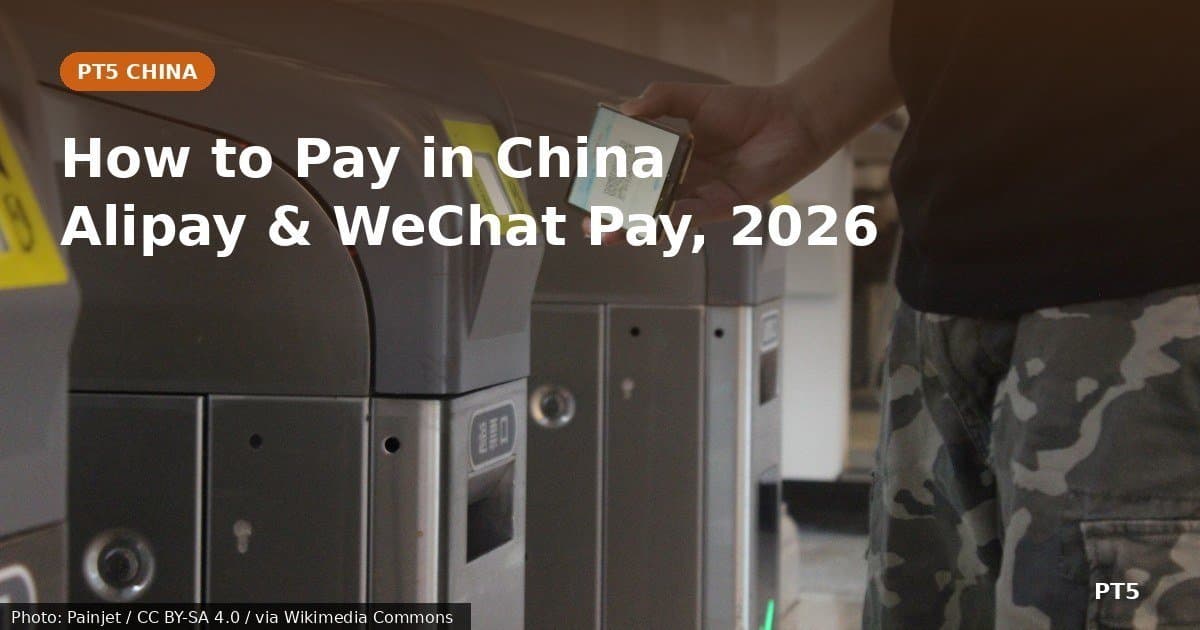
Photo: Painjet / CC BY-SA 4.0 / via Wikimedia Commons. Cropped, resized and overlaid with text. Source: commons.wikimedia.org/wiki/File:Passengers_exit_or_enter_Wuhan_Metro_system_by_QR_code_(1).jpg
Quick facts first
- Set up at home, not at the airport. The whole job takes about half an hour, and airport Wi-Fi is where verification steps fail.
- Set up both apps, start with Alipay. Alipay has the smoother verification flow and the stronger English interface; WeChat Pay runs the restaurant QR ordering and mini-programs Alipay does not.
- Seven card networks work in 2026. Visa, Mastercard, JCB, Amex, Discover, Diners Club and UnionPay, on both apps [2][8].
- The fee line is 200 RMB. At or below 200 RMB per transaction the platform fee is 0%; above it, 3% applies to the full amount, and WeChat Pay made that rule indefinite on 2025-11-28 [1].
- Wallet caps matter for shoppers. Alipay: USD 5,000 per transaction and USD 50,000 per year after passport verification. WeChat Pay: 6,500 RMB per transaction, 50,000 RMB monthly, 65,000 RMB per year [2][3].
- Verification sets your ceiling, not just your paperwork. Until your passport check clears, the wallet stays in a limited state: small unverified purchases only, with balance payments and transfers locked [10][11].
- Merchant payments only, cash as the floor. Red packets and person-to-person transfers are blocked on a foreign-card wallet [2]; refusing cash is against the rules, and 500 to 1,000 RMB in small notes is a comfortable float from banks, ATMs or licensed exchange counters [3].
- No Chinese phone number needed for a trip under two weeks; it starts to pay off on longer stays, and whenever you order food or shop online, where the apps expect a local number and a local address (your hotel’s, or the front desk before check-in).
Why China Runs on QR Codes
Set up a payment app before you land. Cash and foreign cards still exist in China, but in daily life they are the exception, not the system.
The numbers behind that claim are not ours. The People’s Bank of China put mobile payment penetration at 86% in late 2023, the highest of any large economy [4].
The street matches the statistics: metro gates, taxis, food stalls, museum tickets, bike shares. The default rail is a QR code scanned by one of two apps.
The government has spent three years pushing the door open wider for visitors. In 2025, border checkpoints logged 82.03 million inbound and outbound crossings by foreign nationals, up 26.4% year on year [6], and payment facilitation is now explicit national policy: higher transaction limits, more supported card networks, and enforced cash acceptance [3][6].

Metro gates take a phone scan: the default rail is a QR code.
The default rail is a QR code: metro gates, buses and small shops all take a phone scan.
Photo: Painjet / CC BY-SA 4.0 / via Wikimedia Commons. Cropped and resized.
Alipay or WeChat Pay: Which Should You Set Up First?
Set up both, and make Alipay your primary wallet. Traveler-facing comparisons and our own onboarding experience point the same way: Alipay’s verification flow is smoother and its English interface is stronger, while WeChat runs restaurant QR ordering and mini-programs that Alipay does not [9]. People who bind only one app eventually meet the day the other one saves them.
| Feature | Alipay | WeChat Pay |
|---|---|---|
| Setup for foreigners | Lower friction, English-first | Similar, slightly stricter checks |
| Foreign cards accepted (2026) | Visa, Mastercard, JCB, Amex, Discover, Diners Club, UnionPay | Same seven networks |
| Platform fee, foreign card | 0% up to 200 RMB per transaction; 3% above, on the full amount | Same |
| International UnionPay card | Exempt from the service fee | Promoted fee-free for mainland payments; confirm in-app |
| Single-transaction cap | USD 5,000 | 6,500 RMB |
| Annual cap | USD 50,000 | 65,000 RMB (50,000 monthly) |
| Red packets / personal transfers | Not supported | Not supported |
| Languages | 16 in-app languages [3] | English interface, less polished |
| Best for | First wallet, transport, daily spending | QR ordering, mini-programs, splitting bills |
Both apps take the same seven international card networks in 2026 [2][8]. If your home country is on the Alipay+ list, you may not even need to bind a card: the official Alipay+ page covers paying in the mainland directly from supported home wallets [7].
How to Set Up Alipay Before You Fly
Fifteen minutes at home on stable Wi-Fi. Airport Wi-Fi makes verification glitchy, and some steps simply fail on bad connections, which is why this belongs on your pre-departure list, not your arrival list.
Step 1 – Download and register. Install “Alipay”, register with your regular international phone number, and choose the International Version when asked. Your number must receive SMS.
Step 2 – Verify with your passport. Real-name verification is mandatory before card binding. Photograph the passport photo page, do the selfie check, and submit. Most verifications clear in minutes; the official expected window is about 24 hours, with worst cases reported at around 72 hours [8].
Step 3 – Add your card. Me, Bank Cards, Add Card, then enter your card details. Binding is usually instant. If a debit card fails repeatedly, try a credit card: travelers consistently report credit cards bind and transact more reliably [8].
Step 4 – Pay. Scan the merchant’s code, or show your own under Money Receive. Any fee is displayed on the confirmation screen before you approve, so nothing lands unannounced.

Four steps, about half an hour at home. WeChat Pay runs the same flow inside WeChat.
PT5 original illustration, with the “Illustrative” footer mark.
How to Set Up WeChat Pay Before You Fly
WeChat Pay lives inside WeChat itself, so there is no second download. The flow is similar to Alipay with slightly stricter checks at verification.
Step 1 – Register WeChat with your international phone number. Expect one step here that Alipay does not ask for: accounts registered from outside the mainland are commonly required to have an existing user confirm the registration, and that request comes with a time limit, so it has to be answered while both of you are online. For a first-time visitor with no contacts in China, this is the likeliest place to get stuck [12].
Step 2 – Open the wallet. Me, then Pay and Services (or Services), then Wallet.
Step 3 – Verify and add a card. Wallet, Bank Cards, Add a Bank Card, agree to the terms, upload your passport when prompted, and set a six-digit payment password. If the first verification attempt fails, wait a day and retry; that is a known quirk, not a dead end.
Step 4 – Claim the current perks. Per WeChat Pay’s May 2025 announcement, first-time binders of an international card get the 3% fee waived for 60 days on purchases under 1,000 RMB, worth up to 30 RMB saved per transaction, and every international-card user keeps the permanent waiver on transactions up to 200 RMB [5].
One caution circulating in traveler communities, not an official rule: heavy VPN use during payment is reported to raise the odds of a risk-control hold. If you use a VPN, consider paying with it switched off until your account has some history.
Why install WeChat even if Alipay is your wallet. WeChat is the largest and most-used social platform in China, and a great deal of trip logistics runs through it: restaurant QR menus and table ordering, mini-programs for tickets and bookings, group chats with hosts, guides and drivers. It also carries a strong built-in translation system, which turns a Chinese-only screen into something you can act on. Few things improve a first trip as cheaply as having WeChat installed and working before you fly.
If registration stops at the friend-verification step, you do not have to solve it alone. PT5 runs a WeChat group in which our agents help visitors through their WeChat registration verification free of charge. Ask us on WhatsApp and we will add you to the group.
What Does a Foreign Card Actually Cost in China?
One rule covers almost everything: transactions of 200 RMB or less carry no platform fee, and above 200 RMB a 3% service fee applies to the full amount, not just the excess. WeChat Pay’s official announcement of November 28, 2025 made this rule indefinite by removing the old end-date wording [1].
| You pay | Platform fee | Charged to your card |
|---|---|---|
| 180 RMB dinner | 0 RMB | 180 RMB |
| 200 RMB exactly | 0 RMB | 200 RMB |
| 201 RMB | 6.03 RMB | 207.03 RMB |
| 500 RMB train ticket | 15 RMB | 515 RMB |
Three consequences worth acting on.
Split large purchases when it is natural to do so. Two 190 RMB payments cost nothing in fees; one 380 RMB payment costs 11.40 RMB. Merchants are generally fine with two scans if you ask.
Mind your own bank, not just the app. Your card issuer may add its own foreign-transaction fee on top of the platform fee, which is why a no-foreign-transaction-fee card is the one to link first. Check your issuer’s policy before you fly.
Use the UnionPay route if you can. An international UnionPay card is exempt from the Alipay service fee entirely, per Alipay customer service (captured May 2026) [8]. On WeChat, international UnionPay is promoted as fee-free for mainland payments as well; confirm in-app before relying on it.

Under 200 RMB costs nothing. Above it, 3% applies to the whole amount, not just the excess.
PT5 original illustration, with the “Illustrative” footer mark. Every figure in it traces to this article’s text.
What Are the Limits on a Foreign-Card Wallet?
Foreign-card wallets are for merchant payments only, and the caps matter for shoppers more than tourists. Alipay allows single transactions up to USD 5,000 and USD 50,000 per year after passport verification, limits raised from USD 1,000 and USD 10,000 in spring 2024 as part of the national payment push [3]. WeChat Pay caps single transactions at 6,500 RMB, monthly volume at 50,000 RMB, and annual volume at 65,000 RMB, per its official Help Center [2].
Those caps assume that passport verification is finished, and that is the part travelers get backwards. Until verification clears, the wallet stays in a limited state: under WeChat Pay’s own service terms for international cards, an account with a card bound but no completed real-name verification can only make quick-pay purchases, with no balance payments, no top-ups and no transfers in or out [11]; official guidance describes the same arrangement as unverified small-amount payment within a ceiling the platform sets, and submitting identity information is what raises the limit [10]. Alipay is stricter still: real-name verification is mandatory before a card can be bound at all [8]. The practical reading is to verify at home, not on the morning you want to buy a train ticket.
Neither app supports red packets, transfers to individuals, or financial products with a foreign card [2]. If a Chinese friend offers to send money for a shared dinner, the transfer cannot land in your wallet; settle in cash or let them pay.
If you ever hit these walls, the backups are simple. Cash is legally protected: refusing it is against the rules, and the official visitor guide points to banks, ATMs, and licensed exchange counters as the places to get it [3]. For a typical one-to-two-week city trip, 500 to 1,000 RMB in small notes is a comfortable emergency float. One practical caveat: because almost everyone pays by phone, most shops do not keep small change ready, so breaking a large note can be genuinely hard. Carry small denominations and treat a big note as a last resort.
The model many cities formalized in 2025 says it best: large payments by card, small payments by QR, and cash as the floor. Taxis in cities like Guangzhou even carry small-change kits for cash riders [6].

Cash still works, and refusing it is against the rules: 500 to 1,000 RMB in small notes is a comfortable float.
Do You Need a Chinese Phone Number?
For a trip under two weeks, no. Everything above works on your home number, and that path was built for you.
A Chinese +86 number starts to earn its keep in narrower cases: you are staying a month or more, you keep meeting the edge cases above, or you want the deeper local app ecosystem, where some mini-programs and booking services behave better with a local number receiving the codes.
A Chinese number also unlocks the delivery layer. Food-delivery and online-shopping apps in China treat a local mobile number and a local address as the default: the courier calls the number on the order and hands the parcel over at that address. If ordering in or buying anything online is part of your trip, that is where a Chinese number stops being optional. The address half is easier than it looks: use your hotel’s address, and when you order before check-in and have no room number yet, put the hotel front desk down as the delivery point and ask for the parcel to be left with reception.
The mechanics are less exotic than they sound. A foreign passport can legally register a Chinese SIM, both apps accept a Chinese number for registration while your passport still does the real-name verification, and your wallet stays yours; only the phone number changes. The real bottleneck for a short-term visitor is hardware and logistics, not paperwork: where do you get a working Chinese number without navigating a carrier store in a second language? That last mile is a service gap, and it is one of the things PT5 covers below.
When Things Go Wrong: Five Common Problems
Verification fails or hangs. Retry on stable Wi-Fi, check your passport number character by character, and give it 24 hours before worrying. Alipay’s documented worst case is about 72 hours [8].
A payment gets declined with a risk-control notice. Stop retrying, since each attempt looks worse to the system. Switch networks, pay for something small to rebuild trust, and if the hold persists, use in-app support, which Alipay offers in English.
A small vendor refuses your foreign-card wallet. Rare, but it happens with personal QR codes that only take domestic transfers. Try the other app, pay cash, or walk to a chain store. Cash still works: refusing it is against the rules in China [3].
You need a refund. Refunds go back to the original card, and the platform fee is reimbursed proportionally [1]. Keep your payment records; refunds to international cards can take several business days to appear.
You left setup to the airport. Sit down, use the free airport Wi-Fi, and expect it to take twice as long. Better: never let it come to this.
FAQ: Quick Answers
Do I need a Chinese phone number to use Alipay or WeChat Pay? No. Both apps register and run fine on an international number, with your passport handling identity verification. A Chinese number helps on longer stays and with some local mini-programs, as covered above.
Can I just use my foreign credit card everywhere? No. Foreign cards work at hotels, malls, and POS terminals with network logos, but street vendors, small restaurants, taxis, and ticket machines usually want QR payment. Set up at least one app.
What happens if my dinner costs 201 RMB? The 3% fee applies to the full amount, so you pay 207.03 RMB, not 201.03. Splitting into two payments under 200 RMB each costs nothing extra [1].
Can someone send me money through WeChat? Not on a foreign-card wallet. Red packets and person-to-person transfers are blocked for international cards on both apps; merchant payments only [2]. Settle shared costs in cash or let the other side pay.
Is cash still accepted in China? Yes, and refusing cash is against the rules [3]. Get RMB from bank ATMs, banks, or licensed exchange counters. For a short trip, 500 to 1,000 RMB in small notes covers most emergencies; most shops do not keep small change ready, so carry small notes rather than large ones.
When should I do all this setup? At home, before you fly, on stable Wi-Fi. The full pass, both apps plus verification plus card binding, takes about half an hour and saves you the airport version of the same task.
Your Pre-Trip Payment Checklist
The whole guide in nine lines:
- Download both Alipay and WeChat at home, not at the airport.
- Complete passport verification on both, on stable Wi-Fi.
- Bind a no-foreign-transaction-fee credit card first; Visa or Mastercard credit cards bind most reliably [8].
- Add an international UnionPay card if you have one, for fee-free large purchases on Alipay [8].
- Plan to keep taps under 200 RMB where natural; above that, 3% applies to the full amount [1].
- Withdraw or exchange 500-1,000 RMB in small notes as your cash floor.
- Save your payment password somewhere safe (a password manager, not your camera roll), and note each app’s support entry point.
- Staying a month or more? Consider a Chinese number for verification and local apps.
- If you use a VPN, plan to switch it off during payments.
Where PT5 Fits In
Setting this up alone is very doable, but when a verification hangs on arrival day or a risk-control hold freezes your wallet an hour before a train, you want a person on the ground, not a FAQ page. PT5’s support is built around the three moments that matter most for payments, anywhere in China:
- Before you fly: apps installed, WeChat verified. Before you land, a PT5 advisor helps you install the apps you need and walk WeChat verification through under your own passport, so your payment apps work from day one. If a rule changes, we adjust the plan with you on WeChat or WhatsApp.
- After you land: a digital kit or a phone with a Chinese number. A PT5 digital kit, or a phone with a Chinese number, solves the practical pain points of arriving travellers: payments first, and the local apps and verification that unlock them too.
- When a payment gets blocked: a small RMB payment, on the spot. When the system itself gets in your way, a PT5 advisor can make a small RMB payment through a designated PT5 account, settled before you leave. Every payment lands in your service chat with a screenshot, so you can verify every yuan yourself.
Planning a trip and want your payments working before wheels-down? Message us on WhatsApp and a PT5 advisor will set things up with you remotely and point you to the right option for your trip.
The Short Version
Read nothing else and you still need four things. Set up both apps at home on stable Wi-Fi, binding a credit card with no foreign-transaction fee first. Keep taps at or under 200 RMB where it is natural, because that is the fee-free line, and hold 500 to 1,000 RMB in small notes as the floor under everything. Then plan for the part nobody can plan: a verification that hangs, or a risk-control hold an hour before your train, where the difference is whether a person on the ground can pick it up for you.
Traveling soon and want your wallet working before wheels-down? An advisor walks you through the setup remotely, in your language.
Sources
Retrieved 2026-09-07; re-checked 2026-09-08; [2], [3] and [10]-[12] opened again on 2026-09-13. Every tag in the text maps to exactly one entry below, and every entry below is cited at least once in the text.
[1] WeChat Pay (TenPay) official announcement, “Rules on International Card Payment Services”, revision dated 2025-11-28 — https://posts.tenpay.com/posts/78b5788069294f33006bf2ce60e40893.html
[2] WeChat Pay official Help Center, “Guide to Add and Use International Cards with Weixin Pay” — https://help.wechat.com/cgi-bin/micromsg-bin/oshelpcenter?t=help_center/topic_detail&opcode=2&id=2307257v3auq230725eifffi
[3] gov.cn (English), “Payment service guide for overseas visitors to China”, 2024-04-11 — https://english.www.gov.cn/news/202404/11/content_WS6617c858c6d0868f4e8e5f4d.html
[4] China News Service, PBOC deputy governor: mobile payment penetration 86%, 2023-12-28 — https://www.chinanews.com.cn/cj/2023/12-28/10137123.shtml
[5] TMTPost, “WeChat Waives 3% Fee on Transactions Below RMB 200 for International Card Users”, 2025-05-28 — https://en.tmtpost.com/news/7580034
[6] China Economic Net, inbound travelers and payment facilitation, 2026-02-27 — http://www.ce.cn/xwzx/gnsz/gdxw/202602/t20260227_2790612.shtml
[7] Alipay+ official page, “Pay in the Chinese mainland” — https://www.alipayplus.com/my/pay-in-the-chinese-mainland
[8] chinafortravelers.com, “Alipay for Foreigners: Bind a Foreign Card”, updated 2026-08-15 (includes captured official Alipay customer-service screenshot dated 2026-05-18 confirming the fee rule and UnionPay exemption) — https://chinafortravelers.com/guides/alipay-for-foreigners/
[9] Trip.com, “Alipay vs WeChat Pay: Which to Use for Foreign Tourists in China”, updated 2026-08-27 — https://www.trip.com/guide/info/alipay-vs-wechat-pay.html
[10] People’s Daily Overseas Edition, “Payment service optimisation picks up speed”, 2024-03-20 — http://paper.people.com.cn/rmrbhwb/html/2024-03/20/content_26047768.htm
[11] WeChat Pay (Tenpay) User Service Agreement, appendix for international-card users — https://help.wechat.com/cgi-bin/readtemplate?lang=zh_CN&check=false&nav=faq&t=weixin_agreement&s=pay
[12] China.org.cn, “How to keep foreign visitors from feeling out of place when paying: departments step in”, 2024-03-02 — http://news.china.com.cn/2024-03/02/content_117031288.shtml
Photo credits
- Cover: Photo: Painjet / CC BY-SA 4.0 / via Wikimedia Commons. Cropped, resized and overlaid with text.
- In-article photo: Photo: Painjet / CC BY-SA 4.0 / via Wikimedia Commons. Cropped and resized.
- Infographics 3-5: PT5 original illustrations.
 Chat on WhatsApp
Travel notes & questions
Conversation
Loading the conversation…
Want to join in? Sign in to your PT5 China account.