
Destination
Chengdu 2026: Pandas, Teahouses, 3 Days
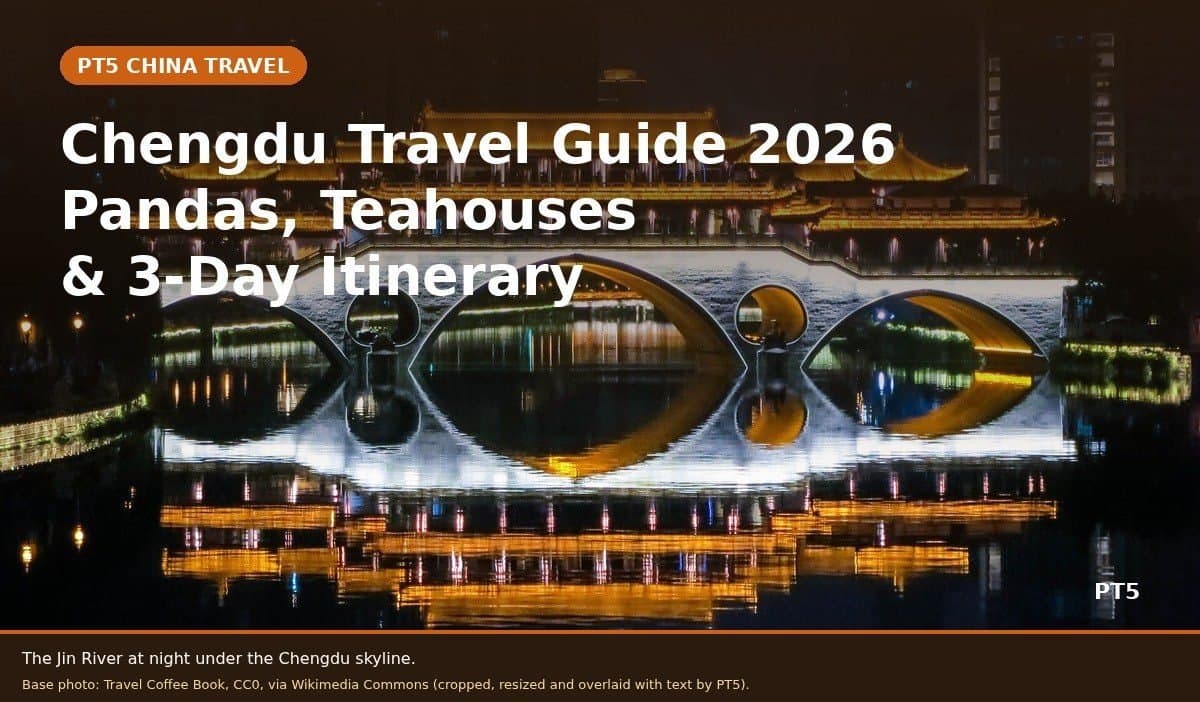
Summary: Chengdu runs on animal clocks and long teahouse afternoons, not on a sightseeing count. Book the panda base for the first morning slot, give a full day to Dujiangyan and Qingcheng, hand your afternoons to a teahouse, and three days are enough. This guide covers the booking rules, the metro and intercity links, and the hours worth avoiding.
The decisions come before the sights
Chengdu goes wrong for one reason: treating it as a place to tick off. Two decisions shape these three days. Is your panda ticket for the morning or the afternoon? And which metro line does your hotel sit on? The pandas are the one part of the plan that will not move for you.

Six numbers that shape a Chengdu trip
| Days needed | Three full days: pandas, Dujiangyan, the old town. Add a fourth for Leshan or Sanxingdui |
| Book before you fly | The panda base morning slot, timed online tickets for Dujiangyan and Mt Qingcheng, and a Sichuan opera seat[14] |
| Panda base ticket | ¥55 (about US$8.2) adult, ¥27 (about US$4) student; bookable 14 days ahead, and it sells out[1] |
| Panda base hours | March to October: morning entry from 07:30, afternoon from 12:00, park clears at 18:00. November to February runs half an hour later[1] |
| Metro fare | From ¥2 for the first 4 km, and no more than ¥13 (about US$1.9) for the longest single journey[8] |
| To Dujiangyan | Metro Line 2 to Xipu, then a same-platform intercity train: 20 to 30 minutes for about ¥10 (about US$1.5)[11] |
1. Why Chengdu, and who should skip it
Chengdu is the slowest city on this route and the one that least rewards a must-see checklist. Its two real assets are the pandas, and a way of spending a day in which nobody hurries you. The teahouse is not a sight but the city’s shared living room: one covered-bowl tea, one bamboo chair, and locals sit there all day.
Come if you want fewer steps, real pandas, and an afternoon that is only tea. Reorder the trip if you mean to fit pandas, Dujiangyan, Wuhou Shrine and Leshan into two days: you can rush Chengdu, but you will spend it in queues and taxis.

No-repeat rule: payments, connectivity and eSIM, hotel types, scams and safety, high-speed rail, seasons and crowds, and dish-by-dish pricing are referenced, not rewritten. The linked posts carry the full versions.
2. What you must book before you fly
Chengdu has few hard reservations, and the panda base is the one that matters. Without a morning ticket you will spend the day looking at sleeping pandas. The rules below follow the official sources at the end, with prices rechecked in the week of publication.
Chengdu Research Base of Giant Panda Breeding
- Booking: real-name online booking for everyone, capped at 85,000 visitors a day. Book through the base’s WeChat account or mini-program, or an authorised platform; without a Chinese mobile number, use Trip.com or the on-site window, cash or card, if tickets remain[12].
- How far ahead: tickets open 14 days in advance and sell until the daily quota runs out[1]. In peak season the morning slots go first.
- Tickets: ¥55 adult, ¥27 student. Visitors aged 60 and over, and children under 6 or under 1.3 m, enter free without booking[1].
- Time slots: from March to October the base runs on timed entry, with the park clearing at 18:00; November to February opens half an hour later. The base asks afternoon-ticket holders not to arrive early, or you simply wait outside[1].
- Gates: the south gate serves the older park, the west gate the newer expansion; both take individual visitors, each reached by shuttle from Metro Line 3[2].
- Refunds: free before 17:00 on your visit day, then a 20% fee per ticket for seven days, after which the order closes with no refund[1].
Dujiangyan and Mt Qingcheng
- The two sites sell separate tickets and admit on real-name, swipe-your-document entry. Book online first, especially at weekends and on holidays. Dujiangyan is ¥80 (about US$12) adult, half price for students[11]; Mt Qingcheng’s front mountain is ¥80, its back mountain ¥20 (about US$3)[5].
- Hours run roughly 08:00 to 17:30 or 18:00 and shift with the season[5]. Booking windows are long; follow the official ticketing page on the day.
Wuhou Shrine and Jinli
- Wuhou Shrine is ¥50 (about US$7.5) full price, ¥25 (about US$3.7) half price, booked online and entered with your original document. Hours are 08:30 to 18:30, last entry 17:30[6]. Unlike the Forbidden City or the National Museum it does not close on Mondays, though events can change that, so check the notice.
- Jinli Ancient Street sits next to the shrine and needs no ticket: open 08:00 to 22:30, shops until around 22:00[7].
Sichuan opera
- The show foreign visitors most often attend is Shufeng Yayun by the Cultural Park: nightly around 20:00, roughly 90 minutes, tea included, tiered seats. Local listings put it at about ¥80 to ¥260 (about US$39), with extra shows in peak season[14]. Confirm the day’s schedule and price when you book.
- Teahouses in Jinli and Kuanzhai Alley run short face-changing sets for a few tens of yuan, usually 30 to 40 minutes. Convenient, but they trim the face-changing itself, so ask about tea and any minimum spend before you sit.
On paid “fast entry” and resellers: the base states plainly that unauthorised third-party sales are banned and no paid fast-entry channel exists, with one document per ticket and entry refused to anyone else. Your passport details are your own risk to carry.

3. The three days that work
These three days follow one rule: the pandas own the morning. Anything that can move gets moved, because your panda slot is the one booking that cannot be changed.
Day 1 · Pandas and teahouses
07:00 leave the hotel and be at the gate when the base opens, first the nursery and the young pandas → out around 11:00 → lunch in the city → 14:30 Heming Teahouse, one covered-bowl tea until early evening → Kuanzhai Alley → hotpot.
Day 2 · Dujiangyan and Mt Qingcheng
07:30 Metro Line 2 to Xipu, changing in-station to the intercity train → 08:15 on board → 09:00 Lidui Park for the irrigation system, about 90 minutes → lunch, then a taxi to the Mt Qingcheng front gate, 25 minutes → evening train back → dinner in the city.
Day 3 · The old town and the opera
09:00 Wuhou Shrine → 11:30 Jinli for lunch and a slow walk → 14:00 a teahouse break → 17:00 dinner → 20:00 the face-changing show, either by the Cultural Park or at a Jinli teahouse.
Two places that need their own day
Leshan’s Giant Buddha and the Sanxingdui museum in Guanghan both sit outside the city, each worth a full day. Force either into three days and Dujiangyan is what you drop.

4. Where to stay: the bases that fit
Chengdu has one useful rule for choosing a base: stay on Metro Line 2, 3 or 1. Those lines link the north side toward the panda base, People’s Park with Kuanzhai Alley, and Wuhou Shrine with Jinli. For hotel types and rooms, see our hotels post; this section is location only.
Chunxi Road / Taikoo Li
Best for a first visit and for staying in the middle of things. Lines 2 and 3 interchange here, and the panda base is a direct metro ride.
Kuanzhai Alley / People’s Park
For walking to a teahouse in the morning and strolling home at night. Strongest old-town atmosphere, thinner walls in the older buildings.
Wuhou Shrine / Jinli
The best value if you want to be closest to the sights; Jinli is lively at night, which suits the old-town day.
Northern Chenghua, toward the base
Only if catching the base at opening matters most and you would rather not take a dawn taxi. Fewer restaurants, little to do at night.
Around Chengdu East station
For an early train or a next-day transfer to Guilin: roughly 25 to 30 minutes by car from the old town, so budget the trip in.

5. Getting around: metro, intercity rail, airports
Chengdu’s metro is cheap and dense, and most in-city days need no taxi at all. Only two transfers take thought: the change for the panda base, and the intercity connection for Dujiangyan.
Fare rules
- Fares run on distance: ¥2 for the first 4 km, then ¥1 for every further 4 km to 12 km, 6 km to 24 km, 8 km to 40 km, 10 km to 50 km, and 20 km beyond[8].
- The priciest single journey on the network is ¥13; tram Line Rong 2 is a flat ¥2[8].
- Tianfutong cards give a 10% e-wallet discount, and phones scan in via the Tianfutong or Chengdu Metro app[9].
To the panda base
- Take Metro Line 3 to Panda Avenue station, leave by Exit A and change to the shuttle for the south gate, the older park[2].
- Alternatively leave Military General Hospital station by Exit B and take the shuttle to the west gate, the newer expansion[2]. Panda footprints inside the station mark the way.
To Dujiangyan and Mt Qingcheng
- Ride Metro Line 2 to its terminus at Xipu and change inside the station to the intercity train, without exiting or re-clearing security. Beyond Dujiangyan the line splits, one branch to Lidui Park, one to Qingchengshan[13].
- The ride is 20 to 30 minutes for about ¥10. For the irrigation system, Lidui Park is the easy stop, a few minutes’ walk from the gate[11].
- Buy both legs before you leave, above all the evening return[16].
Two airports into town
- Shuangliu International: Line 10 reaches Terminals 1 and 2 directly; Line 19 stops at Shuangliu Airport Terminal 2 East[10]. First and last trains fall roughly between 06:00 and 23:00.
- Tianfu International: Line 18 or 19 to Tianfu Airport Terminals 1 and 2, or Tianfu Airport North; Line 19 also runs a direct train between the two airports.
Save taxis for three cases: the early run to the panda base, luggage days, and the ride home from a show. Official guidance puts Shuangliu to the city center at 40 to 50 minutes, and the center to Chengdu East at 25 to 30 minutes; live app quotes decide[10]. For payments, see our payments post.

6. Pandas on their schedule, not yours
Pandas do not perform on demand. They are crepuscular: most active after a big morning feed, asleep once the sun is up[3]. The base opens at 07:30 and advises anyone wanting to see them lively to come early and off-peak[1][4]. This section answers one question: what time to arrive, which gate to use, and how to stay ahead of the coach groups.
Arrive at 07:30, not 09:00
Walking in as the gates open is the best early start in Chengdu. Pandas are liveliest after the morning feed, climbing, tumbling, sparring; once the sun is up, most stop moving. In summer, once afternoons pass 26C, keepers move the outdoor pandas indoors, and activity drops again.
South gate or west gate
The south gate serves the older park, home to the celebrity pandas and the nursery; it is the busiest and the most photo-stop in feel. The west gate opens onto the newer expansion, with fresher enclosures and lighter traffic. For a quick look, either works; for a serious two hours, start west and walk south. Coach groups pour in through the south gate between 09:00 and 11:00, so half an hour earlier keeps you clear.
Staying ahead of the groups
See the busiest enclosures first and double back for the quiet ones; do not follow the crowd in. Once queues build after nine, walk deeper into the park, where pandas are more often eating in peace. Feeding, teasing the animals, drones and skateboards are all explicitly banned.


7. Sichuan opera and the face-changing turn
Face-changing, bian lian, is the Sichuan-opera trick that ends up in every visitor’s photo album: the performer swaps painted masks in a blink, and the fire-spitting turn usually closes the set. The method is a guarded trade secret, which is exactly why it lands as theatre.
Three ways to see it in Chengdu:
- Shufeng Yayun, in the Cultural Park (132 Qintai Road, east gate; metro Line 2 to Tonghuimen exit A or Line 5 to Qingyanggong exit C). Roughly 90 minutes, nightly around 20:00, with tea and snacks served at the table. The programme strings face-changing, fire-spitting, puppetry, shadow play and teahouse service into one evening. Children under 130 cm enter free without a seat of their own, and costume-rental sessions run from 15:00 to 22:00.
- The Sichuan Opera Theatre’s own show at 108 Zhihui Street. About 70 minutes: opening gongs, an excerpt, an erhu solo, then the face-changing and fire-spitting turns. Every ticket includes a gaiwan tea in the theatre’s teahouse, which opens an hour before the performance and is separate from the auditorium. Nightly.
- Teahouse sets in Jinli and Kuanzhai Alley run 30 to 40 minutes for a few tens of yuan. Convenient, but they trim the face-changing turn itself, so ask what is in the programme and whether a minimum spend applies. Heming Teahouse in People’s Park has been pouring tea since 1923, and it is where the teahouse-plus-opera habit comes from.
Two things decide how good the night is. Seats are tiered, and the trick reads best within the first few rows: the tiers are sold by position, so the cheapest row at the back is cheap for a reason. And the face-changing turn comes late, so do not leave at the interval. Buy at the box office or the theatre’s own account; there is no official fast-entry channel and the touts at the door sell the same seat dearer. No flash during the set. Shows run to about 21:30, so eat before rather than after, and both halls are a short walk from a metro station with taxis waiting outside.

8. What to eat, and where
This section answers one question: which district, which meal. Cuisines and prices are covered in our food post.
- Hotpot · Yulin and Jianshe Road. Right for your first night: hot, loud, no menu agonising. Mild is usually spicy enough at first; a split pot is the safe order, and small plates suit small groups.
- Skewers and maocai · residential streets. The everyday hotpot, priced per skewer and done in fifteen minutes, for anyone unwilling to spend two hours on dinner.
- Covered-bowl tea · People’s Park and Kuanzhai Alley. Tea here is not a drink but a seat for the afternoon: one cup, one chair, free refills, nobody moving you on.
- Snacks · sample in the sights, eat properly in the neighbourhoods. Dan dan noodles, Zhong dumplings and Long chaoshou are all in Jinli and Kuanzhai Alley, at higher prices and smaller portions. For a real meal, walk a street or two off the main drag.

9. Two hours off the tourist track
Chengdu is two cities: before 08:00 and after 20:00. These four places need no booking, and most need no ticket. Walk in and you are inside an ordinary Chengdu day.
- Heming Teahouse, People’s Park · 06:30 to 08:30. In the early-tea window a covered-bowl tea is ¥3, free over eighty[15]. That price is a time of day, not a grade of leaf: after 08:30 the same cup runs ¥20 to ¥30 (about US$4.5). Sit in that window and you understand the city.
- Wangjianglou Park · morning. Once home to the poet Xue Tao, with one of the richest bamboo collections in the city and a quiet hour-long loop.
- Kuixinglou Street and Xiaotong Lane · early evening. Beside Kuanzhai Alley, but the restaurants and small bars here feed mostly locals, a notch quieter than the main street.
- Yulin · night. Dense with bars and small kitchens; skewers roadside with the next table’s conversation is the most ordinary Chengdu evening there is.

10. Rules that catch visitors out
- Carry the original ID. The panda base, Wuhou Shrine, Dujiangyan and Mt Qingcheng all check the document you booked with. A phone scan is a backup, not a ticket.
- Buy panda tickets officially. The base states there is no paid fast-entry channel and bans unauthorised resellers: one document, one ticket, no entry for anyone else.
- Morning tickets: arrive at opening. Afternoon tickets: do not arrive early. The base asks afternoon-ticket holders to stay away until their entry time rather than wait outside[1].
- For the irrigation system, get off at Lidui Park station. Dujiangyan station is still some distance from the gate and needs a taxi or bus; Lidui Park is minutes from it on foot.
- Cloud and humidity are the default. Little sun, plenty of moisture: carry an umbrella and a light jacket, and if it rains, swap the panda base’s outdoor stretch for a teahouse afternoon.
- Book the opera ahead. For the nightly show around 20:00 the good seats go first, leaving walk-up buyers the back rows or standing room.
11. FAQ
Can I do Chengdu without speaking Chinese?
Yes. Metro signs are bilingual, the panda base runs a mini-program and a booking route for overseas visitors, and airport lines are signed in English. The two friction points are registering with your passport details and telling a taxi driver where to go: sort the first before you land, and keep your destinations as Chinese screenshots.
What if the morning panda slot is already gone?
Two ways out. Take the afternoon ticket and rebuild the day around it, on the understanding that the pandas will be quieter. Or put the base at the front of the trip, so a morning slot later in your stay is still an option.
Do the pandas have to be a morning thing? Can I go in the afternoon?
Afternoon tickets enter after 12:00, so it is possible, but lower your expectations[1]. Pandas mostly sleep around midday, and in summer the outdoor ones move indoors once the afternoon heats up. The upside is shorter queues; if you want to see them moving, take the morning slot.
Where PT5 Fits In
Chengdu’s difficulty is not the sights but the timetable: the pandas perform only in the morning, the Dujiangyan train has to line up, and the good opera seats go early. Someone on the ground is the most practical help this city offers.
Someone meets you on arrival
Airport pickup at Shuangliu or Tianfu, straight to your hotel door, so you do not decode a metro transfer on arrival.
Someone on call all trip
A companion for the early panda run and the gate choice, teahouse and opera bookings, and a car and companion for the Dujiangyan day, with a fast reply when something goes wrong.
Data and payments ready first
Connectivity and payment set up before you land, so day one is not spent on a lunch you cannot pay for.
Two boundaries, stated plainly
We do not promise safety. We translate, advance small amounts, and accompany you to a police station, hospital or embassy. We do not make police, medical or legal judgments.
Every job is quoted in writing before we start, so the number you agree is the number you pay, and our agents do not accept tips.
If you want those three days handled, join the trip group for Chengdu and we will map it against your dates.
The Short Version
Chengdu is not a city you win by rushing. Book the panda base for the morning and be at the gate when it opens, give the whole second day to Dujiangyan, and leave your afternoons to the teahouse. The city unfolds on its own from there.
Onward from Chengdu
- High-speed rail from Chengdu East to Guilin West takes about five hours at best, with most services running five to seven hours.
- Second class commonly runs from about ¥400 to ¥540 (about US$60–81); check live 12306 fares in the week you travel[16].
- Ticketing, seat choice and transfer buffers are covered in our high-speed rail post.

Sources
[1] Panda base, ticketing and reservation rules – panda.org.cn – read 2026-09-19.
[2] Panda base, public transport and shuttle routes – m.panda.org.cn – read 2026-09-19.
[3] Chengdu Municipal Government, panda base profile – chengdu.gov.cn – read 2026-09-19.
[4] Sichuan Culture and Tourism Department, morning viewing advice – wlt.sc.gov.cn – read 2026-09-19.
[5] Chengdu Municipal Government, Mt Qingcheng hours and ticket – chengdu.gov.cn – read 2026-09-19.
[6] Wuhou Shrine Museum, official site – wuhouci.net.cn – read 2026-09-19.
[7] Jinli Ancient Street, official site – cdjinli.com – read 2026-09-19.
[8] Chengdu Rail Transit Group, fare policy – chengdurail.com – read 2026-09-19.
[9] Chengdu Rail Transit Group, ticketing explained – chengdurail.com – read 2026-09-19.
[10] Chengdu Shuangliu Airport, metro connections and timetables – cdairport.com – read 2026-09-19.
[11] People’s Daily Sichuan, Dujiangyan access and tickets – people.com.cn – read 2026-09-19.
[12] Chengdu Bendibao, 2026 attraction tickets and booking – cd.bendibao.com – read 2026-09-19.
[13] Chengdu Bendibao, Qingchengshan and Dujiangyan day-trip transport – cd.bendibao.com – read 2026-09-19.
[14] Chengdu Bendibao, Shufeng Yayun show times and tickets – cd.bendibao.com – read 2026-09-19.
[15] Sichuan Daily, Heming Teahouse early tea and its history – epaper.scdaily.cn – read 2026-09-19.
[16] China Railway 12306, intercity and high-speed ticketing – 12306.cn – read 2026-09-19.
 Chat on WhatsApp
Conversation
Comments are closed for this guide.