
Destination
Beijing Travel Guide 2026: 3 Days and What to Book
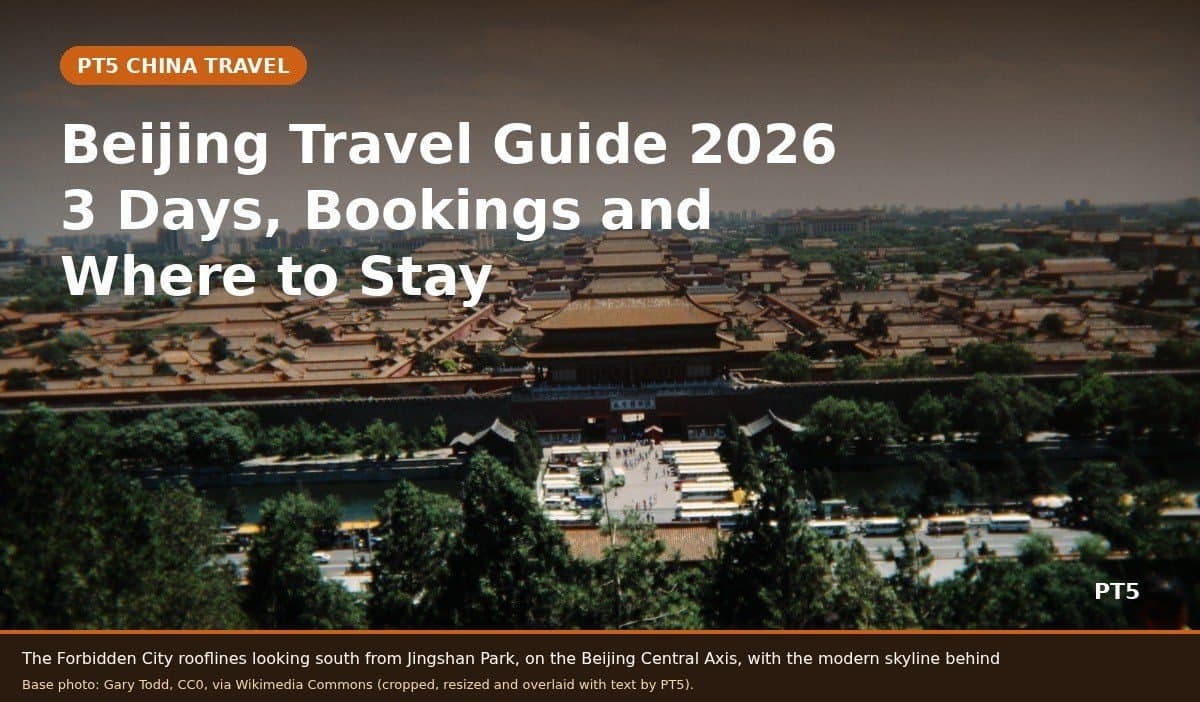
Summary: Beijing is the one city on this route where the booking matters more than the sightseeing list. This guide covers the four reservations that decide your first two days, a three-day plan that survives a sold-out morning, where to sleep so the metro does the work, and how to pick a Great Wall section.
The decisions come before the sights
Beijing is the one city on this route where the planning matters more than the sightseeing list. Three things decide your trip: what you manage to book, how far you are willing to go for the Great Wall, and whether your hotel sits on Metro Line 1 or 2.

Five numbers that shape a Beijing trip
| Days needed | Three full days minimum: one for the axis, one for the Wall, one for the rest of the city |
| Book before you fly | Forbidden City, National Museum, Tiananmen Square, plus a Great Wall ticket |
| Forbidden City ticket | ¥60 peak / ¥40 off-peak; no same-day tickets |
| Metro fare | From ¥3; Capital Airport Express ¥25 flat; Daxing Airport Express ¥10–35 |
| To Badaling Wall | By rail from the north of the city |
1. Why Beijing, and who should skip it
Beijing is the only city here where the state, the dynasty and daily life sit on one continuous line. The Beijing Central Axis runs 7.8 kilometres, was first laid out in the 13th century, and was inscribed on the UNESCO World Heritage List in July 2024[14]. Its 15 elements run from the Drum and Bell Towers in the north to Yongdingmen in the south, taking in Jingshan, the Forbidden City, Tiananmen, the Temple of Heaven and more. You can walk a good part of it in a single day.
Come to Beijing if you want to see how a capital organizes itself: booking systems, security queues, timed entry, a very old city running at very high volume. Think about reordering your trip if you want a relaxed city break, if queues and reservations wear you down, or if Beijing is only a stopover for you. Of every city on this route, Beijing punishes improvisation hardest.

No-repeat rule: payments, connectivity, hotel types, general scams, high-speed rail, seasons and crowd patterns, and dish-by-dish pricing are referenced, not rewritten here. The linked posts carry the full versions.
2. What you must book before you fly
Four Beijing sites run on hard reservations. Without them you stand outside. The rules below follow the official sources listed at the end.
The Forbidden City (Palace Museum)
- Release: tickets open seven days ahead at 20:00 Beijing time, and there are no same-day tickets[1]. The only official channel is the Palace Museum WeChat mini-program; the museum states it authorizes no third-party agents.
- ID: real-name booking for everyone. Foreign visitors book on a passport and must carry the same original document to the gate.
- Entrance: the Meridian Gate is the only way in; you exit at the Shenwu Gate or the East Glorious Gate.
- Slots: morning and afternoon. A morning ticket must be scanned by 12:00; an afternoon ticket cannot be scanned before 11:00.
- Closures: Mondays, except public holidays. Peak season: open 08:30, last entry 16:00, close 17:00[2]. Off-peak: last entry 15:30, close 16:30.
- Tickets: ¥60 peak, ¥40 off-peak. The Treasure Gallery and Clock Gallery are separate tickets.
The National Museum of China
- Free, still booked: reservations open within seven days of your visit and are released daily at 17:00[3], through the museum website, its official mini-program and WeChat account.
- Slots and gate: three entry windows; you verify at the north gate with the original ID you booked with.
- Closures: Mondays except public holidays. 09:00–17:00 with last entry 16:00, extended to 17:30 between 1 June and 31 October.
Tiananmen Square
- Real-name booking: foreign visitors book on an entry passport or residence permit[4], through the official square mini-program or the administration committee’s booking platform.
- Four slots: flag-raising, morning, afternoon, flag-lowering. Watching the flag ceremony needs its own flag-raising slot.
- One rule worth knowing: if you hold a same-day booking for the Chairman Mao Memorial Hall, the National Museum, the Forbidden City, Zhongshan Park or the Beijing Working People’s Cultural Palace, that booking gets you into the square in the morning, afternoon or flag-lowering slot without a separate square reservation[5].
- Window: the bookable range and release time follow what the platform shows on the day; records refresh around midday.
The Great Wall
- Badaling sells tickets through real-name online booking only[6], via its official WeChat account or the official “Great Wall In and Out” channel. Book at least a day ahead in peak season.
- Mutianyu allows on-site purchase[8], but book online for summer weekends and holidays to skip the queue.
On paid “booking agents”: both the Palace Museum and the National Museum state publicly that no third party is authorized, and warn that paid booking agents risk leaking personal data and losing you money[15]. Do not hand your passport details to an unknown channel.

3. The sights worth your time
Decide what you want to see, then count the days you have. The ten below are tagged with the day they take: the first seven fit into three days, the last three each need a half-day of their own.
- Forbidden City (Palace Museum) · Day 1 · book seven days ahead
- Jingshan Park, Wanchun Pavilion · Day 1 · the cheapest big view
- Tiananmen Square · Day 1 · see the booking rule in section 2
- National Museum of China · Day 1 afternoon · free, still booked
- Temple of Heaven · Day 3 at dawn · the local side of the city
- Shichahai and Houhai · Day 1 evening · the walkable finish
- Qianmen and Dashilar · Day 3 · old-brand shopping in daylight
- Summer Palace · needs its own half-day
- Lama Temple and Guozijian · needs its own half-day
- 798 Art District · needs its own half-day
All ten is a five-day trip. On three days, swap at most one of numbers 8 to 10 in for the Day 3 hutong block.
4. The three days that work
The three days follow one rule: put everything that needs a booking or an early start first, and leave the flexible day for last. If a reservation falls through, you still have room to move things around.
Day 2 · The Wall
07:00 departure. Easiest is rail: about 30 minutes from the north of the city to Badaling Great Wall station (section 4). Quieter is Mutianyu, roughly 1.5 hours by road. Back in the city before 18:00; copper-pot hotpot for dinner.
Day 3 · The quiet one
06:30 Temple of Heaven, watch the neighbourhood exercise → Qianmen and Dashilar → afternoon in the hutongs (Nanluoguxiang, or the calmer Guozijian and Wudaoying) → evening transfer to the station or airport.
Three places that need their own half-day
The Summer Palace, the Lama Temple and 798 all sit off the axis. Forcing them into three days turns the trip into a race. Add a day, or swap one in for the Day 3 hutong block.

5. The Great Wall: which section is yours
The Great Wall is not one sight, it is three different days. Choose wrong and you spend two hours in a crowd; choose right and it stays with you. Three questions decide it: how early you can leave, whether anyone in your group is elderly or very young, and whether you actually want to climb.

Badaling: the easiest access
High-speed trains leave Beijing North or Qinghe and reach Badaling Great Wall station in about 30 minutes[7], a few minutes’ walk from the pass. Bus 877 runs from Beitucheng metro station straight to the front mountain, and 919 leaves from Deshengmen. The trade-off is crowds: peak-season days trigger temporary crowd control, and tickets must be booked online with a real name.
Mutianyu: the default answer
The wall here is fully restored, with intact crenellations and solid footing, and the lift or cable car saves the climb. Walk fifteen minutes east or west of the main station and the crowd thins. There is no rail link, so getting there means a coach or a car. For anyone traveling with older family or small children, this is the safest choice.
Jinshanling: for people who want to walk
About 130 kilometres out, this is not a comfortable day trip unless you leave early or hire a car. What you get is the least commercialised stretch and a three to four hour east-west traverse, with some unrestored sections underfoot. Do not go alone if you have little hiking experience.

6. Where to stay: the bases that fit
Beijing has one useful rule for choosing a base: is the hotel near Metro Line 1 or Line 2? Inside that loop, 80% of your itinerary runs on the metro. Outside it, you add roughly forty minutes of travel every day. For hotel types and room choices, see our separate hotels post; this section is only about location.
Shichahai / Nanluoguxiang
For hutong atmosphere and dinners you can walk to. Expect thin walls in old courtyards, and cars cannot reach the narrow lanes.
Qianmen / Dashilar
The best value zone within walking distance of Tiananmen Square, with dense breakfast and late-night food. Good for a city-only three days.
Guomao / Sanlitun
For modern convenience, restaurant choice and a lively evening. A few more metro stops to the sights, but easy for taxis and cars.
Wangjing / airport side
Only for the night before or after an early flight. Forty-five minutes or more into the center; not workable if you sightsee the same day.
Shopping and nightlife, by district
- Qianmen and Dashilar: daylight shopping and old-brand stores, walkable from Tiananmen Square.
- Wangfujing: the easiest shopping street for a first visit, best in the late afternoon; the snack street is a photo stop, not dinner.
- Sanlitun and Guomao: where Beijing actually goes at night, for bars, restaurants and late shopping, a few metro stops from the sights.

7. Getting around: metro, airports, taxis
In Beijing the metro is not the cheap option, it is the quick option. The main sights sit on Lines 1, 2 and 8, and road traffic in peak hours and at weekends is close to unpredictable.
Fare rules
- ¥3 for the first 6 km, ¥4 to 12 km, ¥5 to 22 km, ¥6 to 32 km, then ¥1 for every further 20 km.[12]
- A single journey may last up to four hours inside the paid area; overstay and you pay extra.[9] Do not treat a station as a luggage locker.
- Electronic passes: ¥20 for one day, ¥30 for two, ¥40 for three, ¥70 for five, ¥90 for seven, unlimited rides for one person.[9]
Three ways to pay
- BEIJING PASS card: a smart card made for foreign visitors, ¥20 for the card (non-refundable)[13], bought with a passport at designated machines or service windows, balance capped at ¥1,000. NFC phones can top it up through the SilkPass app.
- Alipay metro ride code: link an international or Chinese bank card and scan straight through, no card needed.
- Station machines or staffed windows: single tickets, with machines taking notes and cashless payments.
Two airports into town
- Capital Airport Express: a flat ¥25 across Dongzhimen, Sanyuanqiao, T3 and T2[11]; first train from Dongzhimen around 06:00, last around 22:30.
- Daxing Airport Express: ¥10, ¥25 or ¥35 by distance in standard cars, ¥50 flat in business class[10]; first train from Caoqiao at 06:00, last from the airport at 23:00, later on Sundays.
Taxis: do not count on speed in peak hours or in rain and snow. Take the metro whenever it reaches your destination; save taxis for luggage days, small children and the early start to the Wall. For payment methods and cash fallbacks, see our payments post.

8. What to eat, and where
This section answers one question only: which district, which meal. Cuisines and price ranges are covered in our food post and are not repeated here.
- Roast duck · Qianmen and Hepingmen. Pick a place that carves in front of you. Half a duck is usually right for two; a whole one is often too much.
- Copper-pot hotpot · Niujie and the southern city. Clear broth, hand-cut lamb, sesame paste. This is the right dinner for the night you come back from the Wall: hot, fast, no menu agonising.
- Breakfast · any older hutong. Fermented mung bean drink with fried rings is a Beijing rite of passage. Do not expect to like it on the first sip. If it defeats you, switch to tofu pudding and sesame flatbread, which is just as local.
- Small hutong kitchens · Shichahai and Wudaoying. Walkable in the evening, no taxi needed, and the most practical dinner plan if you are staying in a courtyard hotel.

9. Peking opera: one evening, and how to enjoy it
Peking opera was formed in this city, not imported to it. The Anhui companies came for an emperor’s birthday around 1790 and never left, and the form they built here runs on four role types: the male sheng, the female dan, the painted-face jing and the clown chou. Movement carries as much of the story as the singing does, which is why an audience that speaks no Chinese can follow a night comfortably: a whip is a horse, four attendants are an army, a walk around the stage is a long journey. The paint is a code too, black for the blunt honest man, red for the loyal one, white for the schemer.
Where to see it. The Chang’an Grand Theatre, in the Guanghua Chang’an building on Jianguomennei Avenue, is the classic house, founded in 1937, and the place to catch a full-length classic or a highlights night of excerpts; it sits a short walk from the Jianguomen interchange on metro lines 1 and 2. The Mei Lanfang Grand Theatre on Dongzhong Street is the National Peking Opera Company’s own stage, with a small upstairs hall for cheaper, shorter programmes. For the intimate version, the old guild and wooden theatres at Huguang Guild Hall and Zhengyici put the audience at tables within a few metres of the performers, and the dinner-show houses run an hour-long cut with surtitles for first-timers.
How to book. Buy through the theatre’s own channel or a ticketing platform, never from a tout at the door, and check the curtain time when you book: most houses start between 19:15 and 19:30 and run two hours or more with a break, while the small historic halls finish earlier and leave you time for a late supper. Seats are tiered and the spread is wide, so a weekday night in the small hall costs a fraction of a weekend gala. The Chang’an Grand Theatre admits no child under 1.2 metres, and tickets are non-refundable once sold.
Getting your money’s worth. Read a plot summary before you go; ten minutes is enough for the twists that matter. Sit in the middle rows rather than the front, because the percussion and the full stage read better from a few rows back. Do not slip out at the interval, since the famous turn often comes last, and keep the flash off during the performance; filming at the curtain call is usually fine.


10. Two hours off the tourist track
Beijing is two different cities before 08:00 and after 16:00. These four places need no booking and no ticket, and they are where the city still looks like itself.
- Temple of Heaven · 06:30–08:00. Buy the park ticket and watch the neighbourhood: choirs, shuttlecock kicking, tai chi, whip practice. The Echo Wall and the Hall of Prayer get busy after 08:00.
- Jingshan’s Wanchun Pavilion · early or late. The easiest full view over the roofs, cheap, and a fraction as busy as the Forbidden City.
- Guozijian and Wudaoying. One notch calmer than Nanluoguxiang: cypress trees, bookshops, small kitchens, a good thirty-minute walk.
- The west side of Houhai. Stay away from the densest bar strip and walk west; you will find chess, caged birds and people simply sitting by the water.

11. Rules that catch visitors out
- Do not plan museums for Monday (section 2). Save Monday for the Wall, the hutongs and parks.
- Security checks are routine. Metro stations, the square and all sites scan bags. Leave lighters and large liquids behind and budget ten minutes.
- Booked means going. Tickets cannot be rebooked. Refund before 24:00 the day before and nothing is recorded. Refund on the day, up to 20:00, and it counts as one no-show. After 20:00 you cannot refund and it still counts as one.
- Have an indoor backup. Dust and high wind make the Wall miserable; keep the National Museum, 798 or a full hutong day as the fallback. Seasons are covered in our best-time-to-visit post.
12. FAQ
Can I do Beijing without speaking Chinese?
Yes. Metro signs and line names are bilingual, the booking platforms run as mini-programs, and airport lines are signed in English. The two real friction points are registering on booking platforms with your passport details, and telling a taxi driver where to go. Sort the first the day before you land, and keep your destinations saved as Chinese screenshots for the second.
What if I cannot get a Forbidden City ticket?
Reorder the trip rather than waiting: take the Wall on day one and move the axis to day three, and keep watching the mini-program at 20:00 for returned tickets. The museum sells no same-day tickets and authorizes no third-party channel.
Which Wall section should I pick with one day?
Short on time and happy on a train: Badaling. Travelling with older family or small children and want a cable car: Mutianyu, which has no rail link, so the day is half road and half wall. Jinshanling is for people who want to walk it and can leave early or hire a car.
Where PT5 Fits In
Beijing’s difficulty is not the sights, it is the process: bookings that fail, days that run out of sequence, half a day lost on the road. Having someone on the ground is the most practical help this city can give you.
Someone on call all trip
A private car and companion for the Wall day, help with reserved venues, a walking companion for the hutongs, and a fast reply whenever something goes wrong.
Data and payments ready first
Connectivity and payment set up before you land, so day one is not spent on a lunch you cannot pay for.
Quoted in writing, and no tips
Every job is quoted in writing before we start, so the number you agree is the number you pay. Our agents do not accept tips.
Two boundaries, stated plainly
We do not promise safety. We translate, advance small amounts, and accompany you to a police station, hospital or embassy. We do not make police, medical or legal judgements.
If you want those three days handled, message PT5 on WhatsApp and we will map it against your dates.
The Short Version
Beijing is not a city you improvise. Book the Forbidden City, the National Museum and the square a week ahead, put the Wall on day two, sleep on Line 1 or Line 2, and the city hands you the heaviest three days this country has.
Onward from Beijing
- High-speed rail from Beijing West to Xi’an North takes about 4 hours 10 minutes at best, with most services running 4:20 to 4:30.
- Fares and seats are only valid on 12306: check again in the week you travel. For how to buy and reserve seats, see our high-speed rail post.
- Most travelers leave from Beijing West: Lines 7 and 9 run there, so allow forty minutes to get through the station.

Sources
[1] Palace Museum, ticketing policy – dpm.org.cn – read 2026-09-19.
[2] Palace Museum, visiting hours – dpm.org.cn – read 2026-09-19.
[3] National Museum of China, booking notice – chnmuseum.cn – read 2026-09-19.
[4] Tiananmen Area Administration Committee, square booking rules – tamgw.beijing.gov.cn – read 2026-09-19.
[5] Tiananmen Area Administration Committee, booking guide – tamgw.beijing.gov.cn – read 2026-09-19.
[6] Visit Beijing, Badaling ticket policy – s.visitbeijing.com.cn – read 2026-09-19.
[7] Beijing Daily, Badaling access guide – xinwen.bjd.com.cn – read 2026-09-19.
[8] Mutianyu Great Wall official tickets – mutianyugreatwall.com – read 2026-09-19.
[9] Beijing rail operator, ticketing rules, August 2026 revision – bjmoa.cn – read 2026-09-19.
[10] Beijing rail operator, Daxing Airport Express timetable – bjmoa.cn – read 2026-09-19.
[11] Beijing Subway official site, Capital Airport Express – bjsubway.com – read 2026-09-19.
[12] Capital Window, public transport fares – beijing.gov.cn – read 2026-09-19.
[13] Beijing English portal, BEIJING PASS procedures – english.beijing.gov.cn – read 2026-09-19.
[14] Xinhua, the Beijing Central Axis inscribed – news.cn – read 2026-09-19.
[15] Beijing Daily, museum warning on paid booking agents – news.bjd.com.cn – read 2026-09-19.
 Chat on WhatsApp
Conversation
Comments are closed for this guide.