Destination
Yiwu Market for Travelers: What to See, Buy & Take Home 2026
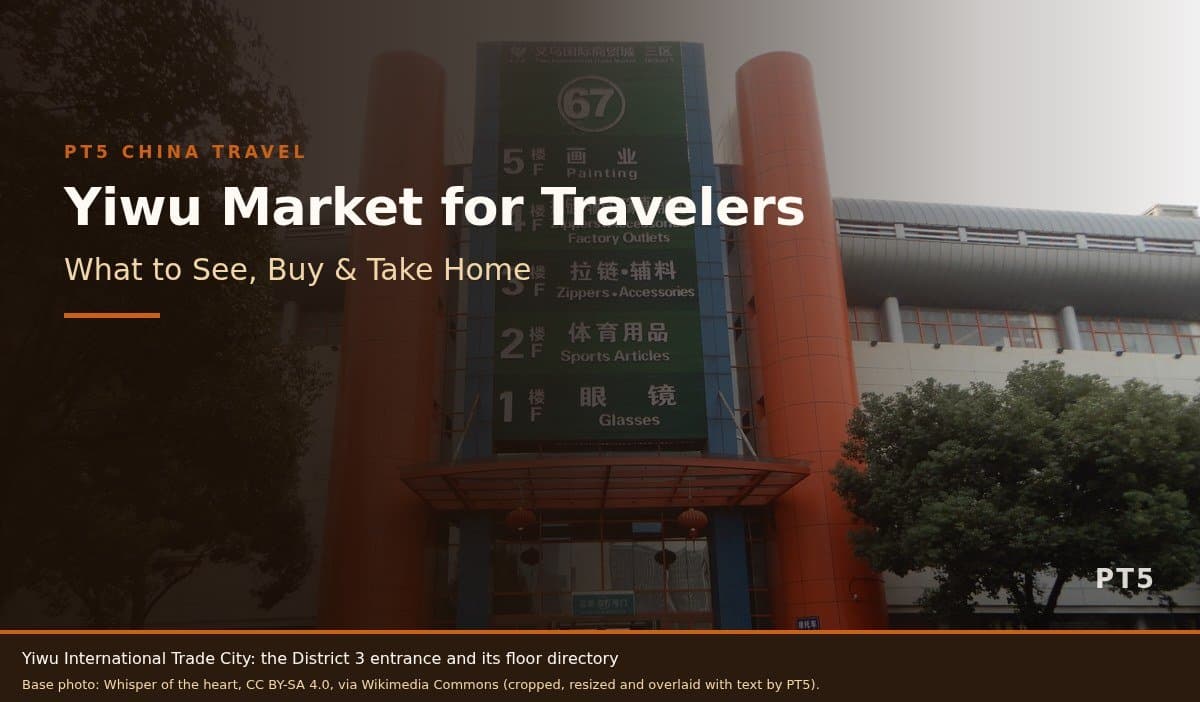
Yiwu International Trade City is the world’s largest wholesale market for small commodities, and for a visitor it works like a free, year-round shopping city: more than 75,000 booths across five districts, about 1.5 hours from Shanghai by high-speed rail. This guide covers getting there, opening hours, which districts are worth your afternoon, how to buy small without wholesale pressure, and how to get your finds home.
Yiwu Market, officially the Yiwu International Trade City, is the world’s largest wholesale market for small commodities [1][2]. That is not marketing: it is a UN-recognized designation for a complex of more than 75,000 booths selling over two million product lines across five districts [8], in a city about 1.5 hours from Shanghai by high-speed rail [2][4]. Importers, Amazon sellers and e-commerce traders from more than 200 countries source here, because it is the single most efficient place on earth to compare dozens of suppliers of the same product in one afternoon [1][4].
For a traveler, the same building is something else: a free, year-round, walk-in market the size of a small city, where you can watch toys, jewelry, home textiles and a million other things being traded in bulk, and quietly buy a few for yourself. This guide is written for that visitor, not for the professional buyer. It covers getting there, opening hours, which districts are worth your afternoon, how to buy small without wholesale pressure, and how to get your purchases home without turning your suitcase into a logistics problem.

Quick facts first
- Yiwu Market is the world’s largest small-commodity wholesale market: more than 75,000 booths, over two million product lines, five main districts and a new sixth-generation center, covering more than four million square meters [1][2][3].
- It is free and open year-round. You walk in like a shopping mall, with no registration and no invitation letter; only about two weeks around Chinese New Year close the whole complex [1][2][3].
- Hours are Monday to Saturday, roughly 9:00-17:00, and they vary from district to district. Most booths close or go quiet on Sundays, and late afternoon (after about 16:30) merchants start packing up [1][2][3].
- The best times to visit are March-June and September-November, when supplier attendance is highest and the market feels most alive [1][3].
- You do not need to buy wholesale. Many stalls, especially District 1’s factory-outlet floor and District 5’s imported-goods mall, sell single items at retail prices, and most others will sell a sample or a small quantity [2][3][4].
- Prices are negotiable and quoted in RMB. First prices are rarely final; even on a small purchase a friendly negotiation usually works [5].
- Alipay and WeChat Pay are accepted by most stalls, international cards are uncommon, and RMB cash works everywhere for small amounts [4][5].
- Getting there is easy: about 1.5 hours from Shanghai by high-speed rail, and a metro line stops at International Trade City station right at the market [2][4].
- Quality is the buyer’s job. Suppliers ship what you order, and nobody inspects a purchase unless you check it yourself; for a small personal buy, that simply means looking at what you are handed [4][5].
1. Yiwu Market at a glance
Yiwu International Trade City, known locally as Futian Market, is a permanent wholesale exhibition complex in Yiwu, Zhejiang Province [2][3]. Unlike the Canton Fair, which opens twice a year, Yiwu is open year-round, and entry is free: you walk in like a shopping mall, with no registration and no invitation letter [2]. The main building stretches roughly 5.5 kilometers, and a metro line stops at International Trade City station right at the market [2].
One fact shapes everything about visiting here: Yiwu is a trading and distribution hub for the industrial clusters around it, not a factory town [2]. An estimated 70-80% of stalls (as of 2026 market guides) are run by trading companies that buy from nearby factories and resell, which means low prices, huge variety and very fast turnover [2]. What you see on the floor is what the world buys in bulk; that is what makes the market such an entertaining place to wander [2][4].
The market is organized so that similar products cluster in the same district and floor, which sounds chaotic from outside but is its best feature: you can compare twenty versions of the same item in an afternoon without leaving the building [2][4].
2. Getting to Yiwu and the market
Yiwu is well connected for a visitor [2][4]. The most common route is the high-speed train from Shanghai: about 1.5 hours to Yiwu station [2][4]. From the station, the metro and taxis connect to the market; the metro line stops at International Trade City station right at the entrance [2].
If you are combining it with a Zhejiang itinerary, Yiwu sits close to Hangzhou and other cities on the high-speed network, which makes it an easy day trip or a one-night stop [2][4]. Book a hotel near the market or in central Yiwu; in the best seasons (March-June and September-November) hotels fill early, so book ahead [5].
A practical note for first-time visitors: the market complex is enormous, so plan your walking. Arrive early, wear comfortable shoes, and treat the visit as a half-day or a full day, not a quick stop [2][3].
3. Opening hours and the best time to visit
The market is open roughly 9:00-17:00, Monday to Saturday, and most booths are closed or lightly staffed on Sundays [1][2][3]. Hours shift a little from district to district, so check the one you plan to visit before you build the day around it. Arrive before 10:00 for the liveliest morning energy and the most complete selection; after about 16:30 many merchants start packing up [3]. The most active window for suppliers is roughly 10:00-16:00 [1].
The whole market closes for about two weeks around Chinese New Year (in 2026, Districts 1-5 closed on the afternoon of February 13 and reopened on February 28), and National Day in early October brings partial closures [1][3]. Check the exact calendar before booking a January or February trip [3].
The best times to visit are March-June and September-November, when factory production is stable and supplier attendance is high [1][3]. If you can, avoid Sundays and public holidays; weekday mornings are the best mix of quiet and fully stocked [1][3].
4. The districts and what you can see
Each district specializes, and within each district, each floor specializes [2]. For a visitor the practical approach is to pick one or two districts that match your interests, not to try to see everything [2][3].
| District | What you will find |
|---|---|
| District 1 | Toys, artificial flowers, jewelry and accessories, crafts, festive decorations |
| District 2 | Bags, luggage, hardware, locks, consumer electronics, watches |
| District 3 | Stationery, cosmetics, eyewear, sports supplies, apparel accessories |
| District 4 | Socks, shoes, daily necessities, hats, scarves, knitwear |
| District 5 | Bedding, curtains, fabrics, pet supplies, imported-goods mall, automotive products |
| District 6 | New Global Digital Trade Center: fashion, smart tech, IP merchandise, skincare (opened 2025) |
For a first visit with no sourcing goal, the friendliest route is District 1 for toys, jewelry and crafts, District 4 for daily goods and apparel accessories, and District 5 for bedding and home textiles [2]. District 1 is the classic starting point: its fourth-floor factory outlet center and east wing are the most tolerant of small retail purchases [2]. District 5 is the most internationally oriented, and its first-floor imported-goods mall is the friendliest place to buy single items at retail [2][3]. District 6, opened as the Global Digital Trade Center in October 2025, reads like a different market: smart tech, licensed IP merchandise and fashion alongside skincare and baby products [2][3].
Yiwu is not the place for precision electronics, high-end apparel or products with tight technical specifications [4]. Its competitive edge is price, variety and speed; for a visitor that means the perfect place for fun, colorful, low-cost finds, and a poor place for serious engineering purchases [4].

5. How to buy as a visitor
You are not there to negotiate a container price. You are there to see one of the world’s great wholesale markets, and maybe to find a few things you love. Here is how to do it without the professional-buyer stress.
Go with a plan, but a light one. Decide which district interests you most, and let curiosity do the rest. If you only have half a day, choose one or two districts and walk them slowly; the market is enormous, and trying to see everything is how people end up seeing nothing [2][3].
Dress for a market day. Comfortable shoes are non-negotiable; you will walk kilometers. Bring a small bag for purchases, a portable charger, water, and a little RMB cash for small buys [4][5].
Talk to the stallholders: they are the show. Most stalls are happy to show what they sell, and many are used to curious visitors, not only serious buyers. Ask what something is, how it is used, and whether they sell to the world market. This is where Yiwu beats any museum: you can touch the toys, hold the jewelry, and smell the goods on the floor [2][4].
Buy small, buy personal. You do not need to meet any minimum. Many stalls sell single items at retail, especially District 1’s retail-friendly sections, District 5’s imported-goods mall and the factory outlet areas [2][3]. If a stall seems wholesale-only, ask politely: “Can I buy just one as a sample?” Most will say yes, some will name a small quantity [4]. Prices are usually reasonable, and a friendly negotiation on a small order usually works [5].
Pay simply. Alipay and WeChat Pay work at most stalls, but both need a Chinese-linked or international-verified account [4][5]. For a traveler the easiest route is usually RMB cash for samples and small purchases, or a China-based helper who pays for you [4][5]. International cards are uncommon on the floor [4].
6. Getting your purchases home
Buying at the market is easy; the packing and shipping are where a traveler can get tangled. Three simple rules keep it painless.
Ask before you assume. Not every booth sells single items, so ask politely: “Can I buy just one?” Most will say yes, some will name a minimum quantity [2][4]. Agree on the price clearly, and ask whether it is the final price. Keep the receipt; it may come in handy at customs when you fly home [4][5].
Carry small things; ship the rest. Small, light purchases (jewelry, toys, scarves, socks, tea) go in your luggage, and remember the market’s goods are ordinary purchases, so check your home country’s duty-free limits before you over-buy [4][5]. Fragile or bulky things (ceramics, lamps, large toys) travel better by courier or freight: air freight takes about 3-7 days at the highest cost, sea freight around 35-45 days at the lowest, and the Yixinou rail line to Europe about 16-24 days in between [6][7]. For anything bigger, a sourcing partner can consolidate your purchases, pack them properly and ship door-to-door.
Bring the stall home with you. Take a photo of the product, the stall and the price. If you love something but do not want to carry it, the stallholder’s card and your photo are enough to order the same thing later; many Yiwu suppliers work with sourcing agents year-round [4][5].
If the whole experience feels overwhelming, that is normal; the market is huge. A local escort can meet you at the station, walk the districts with you, translate the conversation and handle the buying and packing, so you leave with finds, not stress.

7. FAQ: Yiwu questions, answered
Do I need a license or registration to enter? No. Entry is free and open; you walk in like a shopping mall [2].
Is Yiwu Market open on Sundays? Most booths are closed or lightly staffed on Sundays. Plan your visit Monday to Saturday, and arrive before 10:00 for the most productive hours [1][2][3].
Can I buy just one or two items? Many stalls, especially in District 1’s retail-friendly sections, District 5’s imported-goods mall and the factory outlet areas, sell single items at retail prices [2][3]. If a stall seems wholesale-only, ask politely; most will sell a sample or a small quantity [4].
How do I pay as a foreigner? Most stalls accept Alipay and WeChat Pay; international cards are uncommon. The simplest traveler routes are RMB cash for small purchases, or a local helper who pays in RMB for you [4][5].
How do I get my purchases home? Small, light items go in your luggage. Fragile or bulky items travel better by courier or freight: air (3-7 days, priciest), rail to Europe via the Yixinou line (16-24 days), or sea (35-45 days, cheapest) [6][7].
Is Yiwu good for quality products? It is excellent for price, variety and speed on everyday goods, but quality consistency is the buyer’s job: look at what you are handed, and check before you pay [4][5].
Do I need to speak Chinese? Translation apps handle browsing and basic questions [4][5]. For anything complicated, a bilingual helper makes the market much more enjoyable [4][5].
8. Your Yiwu visitor checklist
- [ ] Check the market calendar: avoid Sundays, Chinese New Year closure and National Day [1][3].
- [ ] Take the high-speed train from Shanghai (about 1.5 hours) and book hotels early for March-June or September-November [1][2][4][5].
- [ ] Wear comfortable shoes; bring a small bag, charger, water and a little RMB cash [4][5].
- [ ] Install WeChat and a translation app before arrival [4][5].
- [ ] Pick one or two districts that interest you; do not try to see everything [2][3].
- [ ] Browse before you buy; compare a few stalls for the same item [2][4].
- [ ] Ask politely for a single item or sample if a stall looks wholesale-only [2][4].
- [ ] Agree the price clearly and keep the receipt [4][5].
- [ ] Photograph the product, the stall and the price so you can reorder later [4][5].
- [ ] Decide what to carry and what to ship: luggage for small items, courier or freight for the rest [6][7].
- [ ] Check your home country’s duty-free limits before you over-buy [4][5].
9. Where PT5 Fits In
PT5 is a China travel and sourcing service built on a simple rule: People first, transparent always, with Five Promises that fit each business. For the travel line, those Five Promises are Safe First, Authentic Local, No Forced Shopping, Expert Guide and a Memorable Journey. Yiwu is the most efficient sourcing destination in the world, and buying there with local support is one of our core services, and that is exactly where we come in:
- We plan the most efficient route for you. The market is enormous; covering a single hall in one day is already a real achievement. Tell us what you want to see, and we arrange the most efficient route around your needs, so you do not waste steps.
- Two companion modes: remote or in person. It is normal for a client to have an agent accompanying them at the market, and at PT5 you can choose between remote support and an in-person escort.
- We receive, check, pack and deliver to your hotel. We take delivery of everything, quality-check each item, repack it for travel, and bring it to your hotel, so you fly home with your purchases in your baggage, the tax-free, freight-free option.
- We pack and ship what you cannot carry. Anything too heavy or too large to carry on board, we pack properly and send by sea or air freight to your home address.
- We sort returns for you. If a parcel has a quality problem, or the seller accepts no-reason returns, we handle the return process and the Chinese-language communication for you.
No tips, no surprises. Our agents do not accept tips; the agreed price is the full amount, and we put it in writing before you book.
Transparent pricing. Our sourcing fee is 10% of the product amount for regular clients and 7% for VIP members, charged on what you buy, not on shipping, taxes or card fees.
You can read about all PT5 travel services at pt5china.com.
Message us on WhatsApp with your product list and trip dates, and we will come back with a sourcing plan and a cost estimate.
The Short Version
Yiwu Market is free, open year-round and enormous: more than 75,000 booths across five districts, an easy 1.5-hour high-speed rail trip from Shanghai. Visit on a weekday, pick one or two districts that interest you, and buy small and personal: many stalls sell single items, prices are negotiable, and the market is a fantastic, lively place to wander. Carry small purchases home in your luggage and ship the fragile or bulky ones; keep receipts and take photos so you can reorder later. If you would rather have a local hand with the planning, the walking, the buying and the packing, we can run the whole visit for you.
Sources
All sources were opened and read on 2026-09-15 and re-checked on 2026-09-18. Every tag in the text maps to exactly one entry below, and every entry below is cited at least once in the text.
[1] Yiwu Market Guide 2026: Opening Hours, Locations and District Maps – Toptrade Sourcing, 2026-06-11: toptradesourcing.com
[2] Yiwu Futian Market: A Practical Guide for International Buyers (2026) – Fulfillbot, 2026-07-24: fulfillbot.com
[3] Yiwu International Trade City – China Dragon Tours, 2026-09-15: chinadragontours.com
[4] How to Buy from Yiwu Market in 2026 – New Buying Agent, 2026-03-24: newbuyingagent.com
[5] Yiwu Purchasing Guide – ChineseYiwu, 2025-07-01: chineseyiwu.com
[6] Yiwu to Madrid Rail Freight: 18-Day China-Europe Shipping Solution – Heigten, 2026-02-04: heigten.com
[7] China-Europe Railway Express Transit Times Compared (Yixinou and others) – Shenzhen Shibida Logistics, 2026-09-15: shipsbd.com
[8] Yiwu market scale: more than 75,000 booths and over two million product lines (official figures as of 2024-10) – Qunzhong, 2026-05-25: qunzh.com
 Chat on WhatsApp
Travel notes & questions
Conversation
Loading the conversation…
Want to join in? Sign in to your PT5 China account.