
Visa & entry
China Visa 2026: Visa-Free Routes & 240-Hour Transit
You join the immigration queue at Beijing Capital International Airport, and the family ahead of you hands over a passport and a hotel booking instead of a visa. Ninety seconds later they are through. Whether your queue looks like theirs comes down to one thing: your passport.
China keeps three no-visa routes open at once, each with its own list of countries, its own clock and its own small catch, plus bilateral agreements that work on their own terms. Most travelers walk through one of them without knowing the rules behind it.
China’s visa-free countries and the exemption rules behind them have moved quickly: the transit window stretched to 240 hours in December 2024 [1], the list reached 50 countries by September 2026 [3][5], and Vietnam and Kyrgyzstan joined the transit list on August 20, 2026, taking it to 57 [1][2]. A guide written six months ago can already be wrong in places, so every figure below carries a tag like [1] pointing to an official page you can open yourself. One honest note first: visa rules are set by the Chinese government, not by us, so confirm the current rules on the official pages before you book.

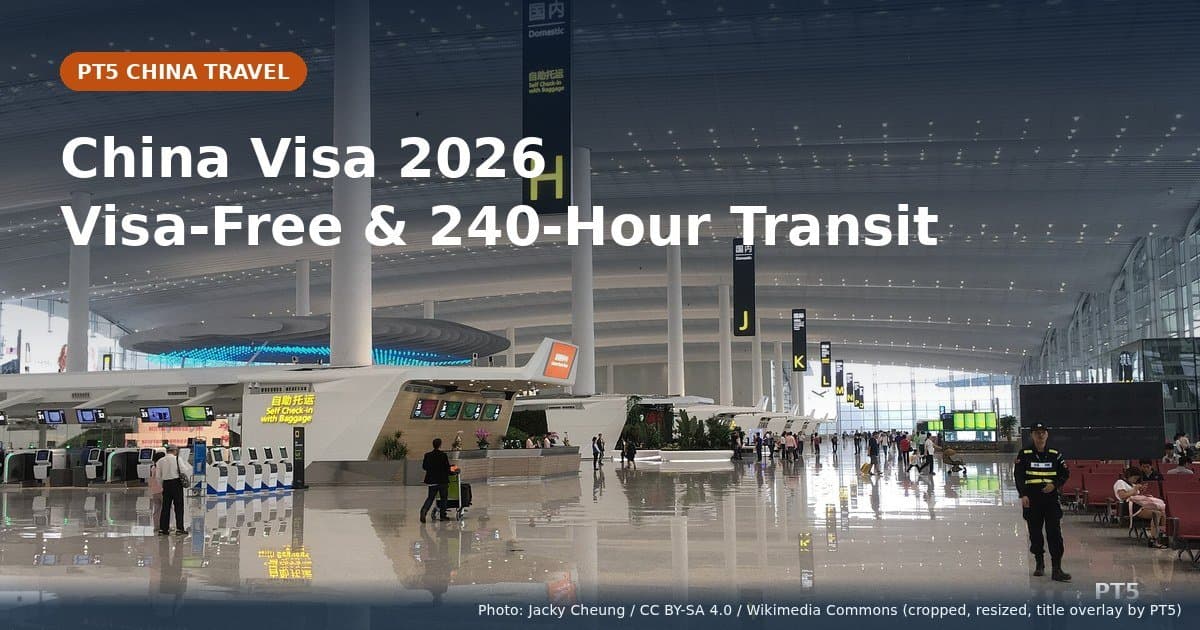
Photo: Jacky Cheung, CC BY-SA 4.0, via Wikimedia Commons. Cropped, resized and overlaid with text.
Quick facts first
- Three no-visa routes, not one. 30 days for 50 nationalities, up to 10 days of 240-hour transit for 57, and Hainan’s own 30 days for 61 [1][3][6].
- Most 30-day entries end December 31, 2026. 48 of the 50 countries run under the current policy only until then; Russia runs to December 31, 2027, and Brunei has no stated end date [3][4].
- Your passport decides the route. Most European passports get the full 30 days. The US and Mexico are not on that list, so they have two other doors: 240-hour transit, or Hainan’s island-only 30 days [1][3][6].
- The transit clock is generous and strict at the same time: 240 hours from 00:00 the day after you arrive, a confirmed onward ticket to a third country or region, and entry only at the 65 designated ports across 24 provincial regions [1][7].
- None of the three routes needs an advance application. The 30-day and Hainan routes need no paperwork at all, and 240-hour transit is issued at the port, with the entry permit sticker accepted at hotel check-in [3][7].
- Register your address within 24 hours if you are not in a hotel; hotels do it for you [10][11].
Do You Even Need a Visa in 2026?
Look at the 30-day list first, then the transit list, then the Hainan and bilateral routes. Only when none of them fits your passport and your trip does a visa become necessary.
| Route | Who it covers | Stay | The catch |
|---|---|---|---|
| Unilateral visa-free | 50 countries [3][5] | Up to 30 days [3] | Listed purposes only; most policies expire Dec 31, 2026 [3][4] |
| 240-hour visa-free transit | 57 countries, incl. the US [1] | Up to 10 days [1] | Must be en route to a third country or region; 65 designated ports only [1][7] |
| Bilateral mutual agreements | Countries with a separate treaty [5] | Varies by treaty [5] | Terms differ per treaty; check your own [5] |
| Hainan regional visa-free | 61 countries [6] | Up to 30 days [6] | You must stay inside Hainan province [6] |
On the 30-day list? Skip the transit rules entirely. Only on the transit list, as the US is? The 240-hour rule is your visa-free door [1][3]. On the Hainan list only? Stay inside the province [6].
The 30-Day Visa-Free Policy: Who Qualifies and What the Rules Are
One sentence covers it: nationals of 50 countries traveling on ordinary passports can enter without a visa for business, tourism, family or friend visits, exchanges or transit, for up to 30 days [3].
The full list as of September 2026, all 50 names from the embassy FAQ [3], grouped as the embassy in Denmark groups them [5]. Find your passport here, not on some random blog:
- Europe (35): Andorra, Austria, Belgium, Bulgaria, Croatia, Cyprus, Denmark, Estonia, Finland, France, Germany, Greece, Hungary, Iceland, Ireland, Italy, Latvia, Liechtenstein, Luxembourg, Malta, Monaco, Montenegro, Netherlands, North Macedonia, Norway, Poland, Portugal, Romania, Russia, Slovakia, Slovenia, Spain, Sweden, Switzerland, United Kingdom
- Oceania (2): Australia, New Zealand
- Asia (7): Brunei, Japan, South Korea, Saudi Arabia, Oman, Kuwait, Bahrain
- Americas (6): Argentina, Brazil, Canada, Chile, Peru, Uruguay
The conditions that trip people up [3]:
- Ordinary passports only. Emergency and temporary travel documents do not qualify [3].
- The 30 days count from midnight after entry, as calendar days [3][5].
- Purposes are limited to the five listed; work, study and journalism are not covered [3].
- No advance declaration, and you may depart to any third country [3].
- All open ports accept it, there is no cap on repeat entries today, and it helps to carry invitation letters, tickets and bookings in case an officer asks [3][11].
How long the policy lasts matters when you book [3][4]:
| Passports | Policy end date |
|---|---|
| Brunei | No stated end date |
| Russia | December 31, 2027 |
| The other 48 countries | December 31, 2026, 24:00 |
Will it still be visa-free in 2027? The December 31, 2026 date reads like an expiry, but every horizon so far has been moved before it lapsed, and always with the same lead time. In November 2024 the government set the covered list’s end date at December 31, 2025 and lengthened the stay from 15 to 30 days [12]; on November 3, 2025 it extended the same policy to December 31, 2026 [13]; Russia’s separate window, which closed on September 14, 2026, was carried to December 31, 2027 on May 20, 2026 [15]. Both mass extensions landed in early-to-mid November, about two months before the year-end date, and the list kept growing in between: Sweden in November 2025, the United Kingdom and Canada in February 2026 [13][14][16]. As of September 13, 2026, no notice extends the 48 countries into 2027; if the pattern holds, the announcement to watch for comes around November 2026. Read that as a pattern, not a promise, then check the embassy page before you book.
Want longer than 30 days? The visa-free routes cannot be extended at the border; if a genuine reason keeps you in China, ask the local exit-entry administration about a stay permit [3].
The 240-Hour Transit: Ten Days Without a Visa for 57 Nationalities
If your nationality is on the 57-country list, you can enter without a visa for up to 10 days while you are in transit to a third country or region [1]. Vietnam and Kyrgyzstan joined on August 20, 2026, completing the current list [1][2].
The 57 span Europe (40 countries, essentially the EU plus the UK, Switzerland, Norway, Iceland, Russia, Ukraine, Belarus and the western Balkans), the Americas (the US, Canada, Mexico, Brazil, Argentina, Chile), Oceania (Australia, New Zealand) and Asia (Japan, South Korea, Singapore, Brunei, Qatar, the UAE, Indonesia, Vietnam, Kyrgyzstan). The full list is on the NIA page [1].
The rules, checked against the NIA and the official Shanghai FAQ [1][7]:
- An onward ticket with confirmed seats and dates to a third country or region, departing within 240 hours [1][7].
- A passport with at least three months of validity at entry [7].
- Entry through one of 65 designated ports across 24 provincial regions; five Guangdong ports joined on November 5, 2025 [1][9].
- The clock starts at 00:00 the day after arrival [7].
- Free movement inside the permitted areas [1][7].
- Tourism, business, visits and family reunions are allowed; work, study and news reporting still need a visa [1].
- You apply on arrival, with no advance application and no embassy visit; border inspection issues a temporary entry permit sticker, and hotels accept it for check-in [7].
Two things catch people out. First, you fill in the Arrival Card for Temporary Entry Foreigners and answer a few questions at the booth. Second, you are ineligible if you were refused a Chinese visa, or have a record of illegal entry, exit, residence or employment in the last five years [8]. Your itinerary also has to move you on to a third country or region, not back to where you started [1][7]. For edge cases, ask the 12367 hotline before you book [8].

Photo: N509FZ, CC BY-SA 4.0, via Wikimedia Commons. Cropped and resized.
Other Routes: Bilateral Agreements, Hainan and Regional Policies
Mutual visa-free agreements are the quieter door: China has separate agreements with a number of countries, each on its own terms, so the length of stay and entry conditions can differ from the unilateral list. Read your own agreement rather than borrowing your neighbor’s [5].
Hainan runs its own 30-day visa-free policy for 61 countries through its open ports, covering tourism, business, visits, family, medical and event purposes, on one condition: you stay inside the province [2][6]. Group-tour carve-outs exist for cruise arrivals and groups arriving from Hong Kong or Macao [6]. The list includes the US, Malaysia, Singapore and Thailand, countries left off the mainland 30-day list [6].
If none of these three routes fits your passport or your trip, you need a visa, applied for at a Chinese embassy or consulate; that application sits outside this guide.
Tip: your visa-free clock can restart. Nearing the end of your window but want to stay in China longer? A common pattern is to exit to Hong Kong, Macao, Southeast Asia, South Korea or Japan for a day or two, then re-enter and start a fresh visa-free period. Two cautions: each entry still has to match a permitted purpose and the port decides case by case, and repeated quick turnarounds can read as de facto residence. If you need months rather than weeks, apply for the visa that fits.
At the Border: Arrival Day, Ports of Entry and the Arrival Card
Border inspection makes the final call and can deny entry when your purpose does not match the policy you are using [3]. Keep bookings, onward tickets and invitation letters within reach on your phone [3][11]. Ports differ by route:
- Unilateral 30-day: every port open to foreigners [3].
- 240-hour transit: only the 65 designated ports; arriving elsewhere on a transit plan fails the policy [1][9].
- 24-hour direct transit: all open ports; since November 5, 2025 ten airports including Tianjin, Nanjing, Qingdao, Wuhan and Kunming are exempt from immigration inspection procedures [1][9].
- Hainan: Hainan’s open ports only [6].
At a 240-hour port such as Shanghai Pudong International Airport, follow the transit signs, present the onward ticket, and keep the permit sticker until you leave; hotels register you with it [7].

Photo: Ranch9613, CC0, via Wikimedia Commons. Cropped and resized.
After You Land: The 24-Hour Accommodation Registration
Hotels register you at check-in; anywhere else, the job is yours within 24 hours [10][11]. Article 39 of the Exit and Entry Administration Law has hotels report foreign guests to the local public security organ; in an apartment, homestay or friend’s place, you or your host register with the police within 24 hours of arrival [10][11].
Since March 20, 2026, seven provincial regions (Hebei, Liaoning, Zhejiang, Hubei, Guangxi, Chongqing, Sichuan) accept online filing through the NIA platform, the 12367 app, or the WeChat and Alipay mini programs. The NIA states that this filing has the same legal effect as filing in person [10][11]. Elsewhere it is the local police station, and the 12367 hotline answers questions [10]. Skipping it has a price: Article 76 provides a warning and a fine of up to CNY 2,000, and hosts are on the hook too [10][11].

Infographic: PT5 China Travel. Illustrative, summarised from official sources, retrieved September 2026.
Troubleshooting: When Things Go Wrong
Your airline refuses boarding. Carriers are conservative, and their decision comes before any officer’s. Screenshot the official policy pages for your route [1][3], show the onward ticket, and ask for a supervisor before accepting a denial.
Border inspection questions your purpose. Stay calm and factual, and show documents that match your stated purpose; officers can deny entry when the purpose does not fit the policy [3]. If it goes badly, ask for an interpreter and call your consulate.
You realize you will overstay. If a genuine reason keeps you past your 30-day visa-free stay, apply for a stay permit at the local exit-entry administration before your time runs out [3]. Penalties are not published as a tidy table, which is why you should not gamble on them.
Your passport is lost or stolen. Emergency travel documents do not qualify for visa-free entry, so leaving is not automatic: report to the police, get documents from your consulate, then work out the exit path with the local exit-entry administration [3].
FAQ: Quick Answers
Do US passport holders need a visa for China in 2026?
Not for every trip. The US is on the 57-country transit list [1] but not the 30-day list [3], so a qualifying onward itinerary works visa-free for up to 10 days. Hainan’s island-only 30-day policy also covers US passports, as long as you stay inside the province [6]. Any other itinerary needs a visa.
How is the 30-day visa-free stay counted?
From midnight on the day after entry, for 30 calendar days [3][5]. Land at 11 pm on the 1st and the clock starts at 00:00 on the 2nd.
Does the 240-hour transit require a ticket to a different country?
Yes: a third country or region, confirmed seats and dates, departing within 240 hours [1][7]. Your itinerary has to move you on to a third country or region, not back to where you started.
What if my passport is on none of these lists?
Then you need a visa, applied for at a Chinese embassy or consulate before you travel. That application and its requirements sit outside this guide; the embassy page for your country is the place to start [3].
Do I have to register with the police if I stay in an Airbnb or at a friend’s place?
Yes, within 24 hours, by you or your host; hotels do it automatically [10][11]. Seven provinces accept online filing through the 12367 channels; elsewhere, a quick police-station visit [10].
Your Pre-Trip Entry Checklist
The whole guide in seven lines:
- Check your passport against the 50-country list before anything else [3].
- Not on it? Check the 57-country transit list and whether your trip genuinely transits onward [1].
- Visa-free: keep tickets, hotel bookings and invitation letters reachable on arrival [3][11].
- Transit: confirmed onward ticket, three months passport validity, entry at one of the 65 ports [1][7].
- Pre-fill the arrival card online for a faster border [9].
- Staying outside a hotel? Register with local public security within 24 hours [10][11].
- Policies move; re-check the NIA and embassy pages right before booking [1][3].
Where PT5 Fits In
Everything above is public policy, and we would rather you check it yourself; the source list at the end is the proof. PT5 is a China travel and sourcing service built on a simple rule: People first, transparent always, with Five Promises that fit each business. For the travel line, those Five Promises are Safe First, Authentic Local, No Forced Shopping, Expert Guide and a Memorable Journey. The visa rules belong to the Chinese government; the ground side is where we help, and it starts with the plan:
- A pre-flight check, in your language. Before you come, a PT5 advisor typically walks you through your preparations — passport and visa-free status, eSIM and apps installed, and the rest of the list — on WeChat or WhatsApp.
- A plan that fits your window. Based on your visa-free period, we recommend an itinerary that fits it, and confirm that your arrival port admits visa-free entry.
- Exit-and-re-entry options. If your plans ask for it, we recommend ways to exit and re-enter China, and confirm the port where you can come back in visa-free.
- Border-permit help for Tibet and Xinjiang. If your route reaches a border-management area in Tibet or Xinjiang, we help you get the Border Management Area Pass sorted: we work through the paperwork with you, tell you where to apply, and check what the local port asks for, so the pass is in hand before you set off.
One thing we keep clear: we are not a visa service. We do not advise on visas or assess whether you qualify. For anything about your own situation, the embassy and the NIA are the only voices that count. What we take off your plate is the ground side, once the paperwork is yours.
Planning a China trip and want the ground side handled before wheels-down? Message us on WhatsApp and a PT5 advisor will help you plan the itinerary and set up arrival support.
The Short Version
If you read nothing else: check your passport against the 50-country list, then the 57-country transit list, then Hainan’s island policy. Each route has one condition that decides it, so match your itinerary to the right route before you book, and register your address within 24 hours if you are not in a hotel. The visa rules belong to the Chinese government, so treat the embassy and the NIA as the last word, and us as the helpers waiting on this side.
Traveling soon and would like someone waiting on this side? An advisor will help with the itinerary and arrival support.
Sources
Retrieved and read 2026-09-08; [12]-[16] opened again on 2026-09-13. Every tag in the text maps to exactly one entry below, and every entry below is cited at least once in the text.
[1] NIA (National Immigration Administration, English), “Visa-Free Transit Policies”, updated 2026-08-20: https://en.nia.gov.cn/n147418/n147463/c183412/content.html
[2] NIA official announcement (Chinese), adding Kyrgyzstan and Vietnam to the 240-hour transit and Hainan 30-day policies, 2026-08-20 (this JSP page renders only in a browser; the English-language version is [7]): https://www.nia.gov.cn/News/news/content.jsp?id=1796332
[3] Chinese Embassy in Greece, “FAQ on the Unilateral Visa-Free Policy”, 2026-07-22 (bilingual): https://gr.china-embassy.gov.cn/lsqw/lszj/fhqz/202607/t20260722_11989965.htm
[4] Chinese Embassy in The Bahamas, “Notice on the Extension of the Unilateral Visa-Free Policy”, 2026-09-03 (use it for the extension to December 31, 2026 of the listed countries; the Russia and Brunei terms come from [3]): https://bs.china-embassy.gov.cn/eng/lsyw/qz/202511/t20251107_11748694.htm
[5] Chinese Embassy in Denmark, “Visa Exemption Situations”, updated 2026-05-18 (Chinese): https://dk.china-embassy.gov.cn/lsfw/qz/202507/t20250710_11668334.htm
[6] NIA (English), “Regional Visa-Free Entry Policies for Foreign Nationals”, updated 2026-08-20: https://en.nia.gov.cn/n147418/n147463/c180637/content.html
[7] english.shanghai.gov.cn (Shanghai municipal government portal, drawing on Xinhua and NIA), “China adds Kyrgyzstan, Vietnam to 240-hour visa-free transit program”, 2026-08-20: https://english.shanghai.gov.cn/en-Latest-WhatsNew/20260820/bcaad9737db44e6ab788dfd785832b6b.html
[8] english.shanghai.gov.cn, “Criteria and notes for expats applying for 240-hour visa-free transit in China”, updated 2026-05-12 (use it for the transit criteria; its country count is older than [7]’s): https://english.shanghai.gov.cn/en-240-hourtransfer-stayinShanghai/20240104/05e535a37f4c41db802e842247425848.html
[9] english.beijing.gov.cn (source: www.gov.cn), “China Expands Visa-Free Transit and Digital Entry Options for Foreign Travelers”, 2025-11-05: https://english.beijing.gov.cn/latest/news/202511/t20251105_4259688.html
[10] NIA (Chinese), “Policy Interpretation: Online Accommodation Registration for Foreigners Staying Outside Hotels”, 2026-03-20: https://www.nia.gov.cn/n741440/n741577/c1771556/content.html
[11] China National Tourist Office (London), “Accommodation” guide, English text of Exit and Entry Administration Law Articles 39 and 76 (page carries no date; read 2026-09-08): https://www.cnto.org.uk/guides/accommodation/
[12] www.gov.cn (Xinhua), “Foreign Ministry: China to expand visa-free coverage to 38 countries” (Chinese), 2024-11-22 (use it for the November 2024 roll-forward to December 31, 2025 and the 15-to-30-day change): https://www.gov.cn/lianbo/bumen/202411/content_6988858.htm
[13] MFA Consular Department, “Notice on the Extension of the Unilateral Visa-Free Policy” (Chinese), 2025-11-03 (use it for the extension to December 31, 2026 and Sweden’s start on November 10, 2025): https://www.mfa.gov.cn/wjbzwfwpt/kzx/tzgg/202511/t20251103_11746081.html
[14] MFA Consular Department, “FAQs on Visa-free Entry into China” (bilingual), 2026-07-21 (use it for the 50-country list and the three end dates): https://cs.mfa.gov.cn/zytz/202607/t20260721_11988631.html
[15] MFA, “Notice on the Extension of the Unilateral Visa-Free Policy for Russia” (Chinese), 2026-05-20 (use it for the Russian extension to December 31, 2027): https://www.mfa.gov.cn/wjbzwfwpt/kzx/tzgg/202605/t20260520_11914502.html
[16] Chinese Consulate-General in Munich, “Notice on the Extension of the Unilateral Visa-Free Policy” (Chinese, pinned), 2026-08-19 (current official statement of the 50-country list running to December 31, 2026): https://munich.china-consulate.gov.cn/chn/lsyw/visum/202608/t20260819_12006667.htm
 Chat on WhatsApp
Travel notes & questions
Conversation
Loading the conversation…
Want to join in? Sign in to your PT5 China account.