Shopping & sourcing
China Shopping Guide 2026: What to Buy and How to Bargain
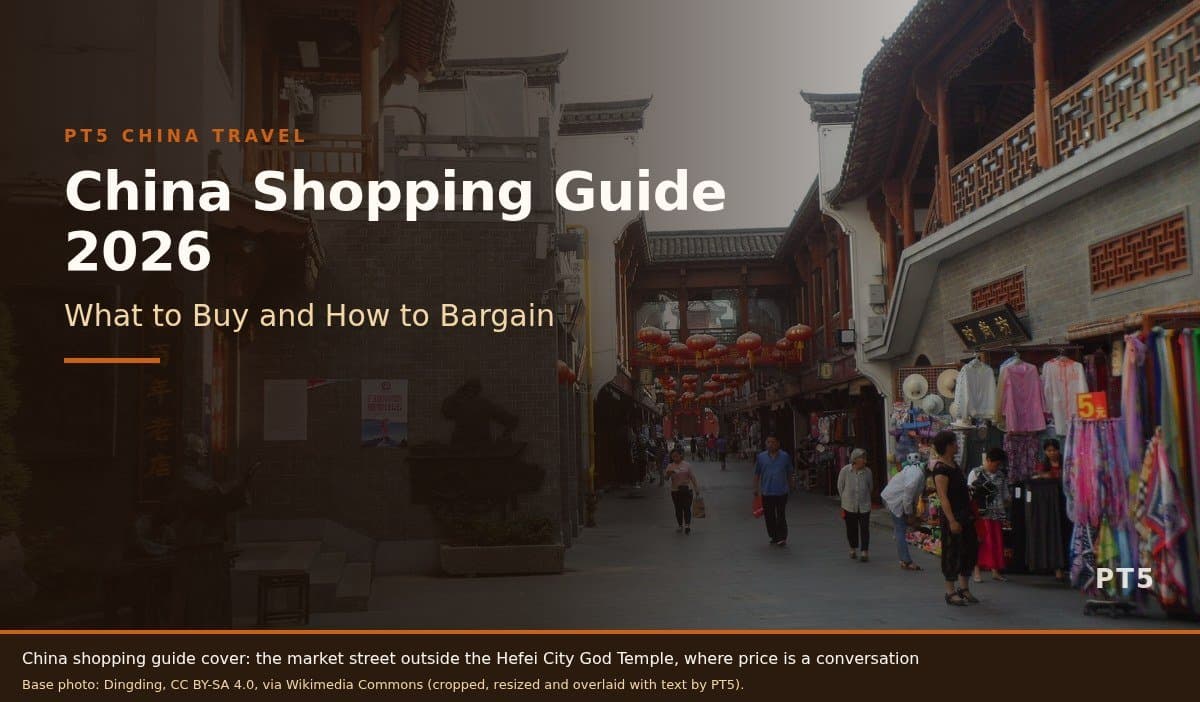
Shopping in China rewards two skills: knowing which places have fixed prices, and knowing which platform sells the same thing for less. This guide covers what is actually worth buying, where to shop without overpaying, how to bargain politely, how the 2026 departure refund works, and how to get everything home.
Shopping in China is not about filling a suitcase with cheap copies. It is about finding things that carry a place: tea picked on a hillside in Hangzhou, silk woven in Suzhou, porcelain fired in Jingdezhen, a dress cut to your body in a Shanghai tailor’s shop [7][8][9]. It is also about the quiet thrill of realizing that the market stall price is not the real price; the real price is usually one screen away on a Chinese platform, or one tax-refund receipt away at a brand store.
This guide covers the six things that matter most: what is actually worth buying, where to shop so you do not overpay (in person and online), how to bargain without offending anyone, how the new tax refund works step by step, how to get your purchases home safely, and how PT5 can handle the parts that are awkward for a visitor.

Quick facts first
- Start with the tax refund. Since 2025 the threshold is just ¥200 (US$30) per store per day; refunds run 11% on most goods (13% VAT) and 8% on books and similar (9% VAT), minus an agent fee of about 2% [1][6][5].
- The 2026 rules are easier. From 1 July 2026: purchases under ¥10,000 are spot-checked at random instead of verified item by item, everything is paperless, and “buy now, refund now” is accepted across ports within 28 days [1][2].
- Almost everything at tourist sights is online too. Most of what you see in markets, malls and scenic areas is sold on 1688, China’s wholesale marketplace, often far below the tourist price; 1688 sellers are typically small-scale taxpayers paying 3% or less in VAT (reduced to 1% through 2027), so prices stay low even without the departure refund [13][14].
- JD, Taobao and Pinduoduo fill the gaps. JD is fast (many items next-day), Taobao has the widest range, Pinduoduo is usually cheapest; all three beat physical-store prices, though they run a bit higher than 1688 wholesale [7].
- Brand stores are the tech bargain. DJI, Huawei, Bambu Lab and similar Chinese brands often cost less in China than abroad, and buying at a tax-refund store adds roughly 9% back [5][6]. Check after-sales, English support and whether the product works in your country before paying.
- Malls have fixed prices; markets do not. Department stores and chain shops almost never negotiate. Night markets, souvenir streets and small shops expect you to bargain: start at 30–40% of the opening price [10][11].
- Carry cash for small stalls. QR-code payments are everywhere, but a small vendor stall may only accept cash or a local wallet; keep ¥200–500 (US$30–75) as a buffer [8].
What’s actually worth buying
Buy fewer, better things is the right instinct in China. Quality varies wildly, and the difference between a ¥50 souvenir and a ¥300 one is often not branding but craftsmanship [8][9]. Here is what genuinely rewards the shopping trip.
Tea. This is the classic, and the most accessible. Dragon Well (Longjing) from Hangzhou, pu-erh from Yunnan, Tieguanyin oolong from Fujian and Keemun black from Anhui are the famous names [7][9]. Decent quality runs about ¥100–500 per 100g (US$15–75); very cheap tea is usually low-grade blends, and the pre-packed “gift sets” sold at airport shops are overpriced for what they are [7]. Buy loose leaf from a specialized shop or a lively market where locals are buying, and taste before you commit [7][8]. Single-serving tins and pressed cakes pack well [8].
Silk. Suzhou and Hangzhou are the silk capitals [7][9]. Scarves and shawls run ¥150–500 (US$22–75), custom qipao and dresses ¥300–2,000 (US$45–300), and silk bedding is a serious step up in quality [8][9]. The quick authenticity test: burn a loose thread end: real silk smells like burnt hair and leaves a crushable ash; synthetic smells like plastic [7]. Department stores and the Suzhou Silk Museum shop are safe, fixed-price places; market silk is cheaper and negotiable, but check quality carefully [7][8].
Porcelain and ceramics. Jingdezhen has been the porcelain capital for centuries, and its name on a box does not always mean it came from there; shop where you can see the piece [8]. Daily-use bowls and tea sets are affordable, hand-painted pieces are the keepers, and a well-packed vase can be the centrepiece of your home [8][9]. Ask the seller to wrap fragile items properly (bubble wrap and a rigid box) and pack them in the middle of your suitcase [8].
Custom clothing. Getting a qipao, suit or shirt made to measure in Shanghai, Beijing or Guangzhou is faster and cheaper than at home, typically a few days and a fraction of a Western tailor’s price [8][9]. Bring or buy the fabric, ask for one fitting, and allow time before you fly.
Electronics and tech. From phones to cameras, drones and earbuds, China’s domestic brands are globally competitive and often far cheaper at home [9]. Shenzhen’s Huaqiangbei is the famous electronics district; but beware grey-market goods and fakes; buy from official stores or large retailers for warranty, and always test the device before you pay [8][9]. Chinese flagships with domestic specs often have no export markup, which makes them a real bargain.
Traditional crafts, stationery and jewelry. Hand-carved name seals (¥80–250, US$12–37), folding fans, ink-wash paintings, cloisonné, paper cuttings and embroidery are all portable, distinctive gifts [8]. Freshwater pearls are a good buy from a trusted stall (earrings from ¥80, US$12; strands ¥200–1,000+, US$30–150) [8]. And if you know jade, or you are with someone who does, jade is China’s signature stone; if you do not, treat it as decoration and pay decoration prices [9].
Snacks and pantry staples. Tea aside, spices, dried fruits, candies like White Rabbit, hawthorn flakes and local biscuits are cheap, light and travel well [8]. They also make the easiest gifts for colleagues.
Everyday drinks are part of the experience, too. Milk tea shops sit on every corner, coffee culture has taken hold in the big cities, and warm soy milk is a street-cart breakfast staple. The one to brace for is herbal tea (liangcha): locals drink it for health, and first-timers usually find it memorably bitter.
The honest rule of thumb: if a “luxury” item is being sold at a street stall for a fraction of its home price, it is almost certainly not the real thing [8]. Buy the category for what it is, and save the big-ticket prestige purchases for authorized stores.

Where to shop without overpaying
China’s shopping landscape splits into two connected worlds: the physical one you walk through, and the online one most tourists never unlock [10]. Here is the whole map.
Malls and department stores: fixed prices, safe quality. National and international chains, department stores and brand boutiques have printed prices, and bargaining is not appropriate [10]. The advantage is authenticity, warranty and easy tax-refund paperwork (stores display the “tax refund” logo) [5]. High-end malls in Shanghai, Beijing, Guangzhou and Shenzhen are also where you find China’s home-grown brands at their best.
Night markets and souvenir streets: theater and negotiation. From Wangfujing in Beijing to the night markets of Guangzhou and Xi’an, these are the places where sellers expect a conversation [11]. The opening price is inflated for tourists; treat it as the start of a negotiation, not a fact [11]. The food stalls are great fun; the “crafts” need careful eyes.
Wholesale markets: prices for buyers, not browsers. Yiwu is the world’s largest small-commodity market, and Shenzhen’s Huaqiangbei and the Beijing Silk Market (Xiushui) sit in the same family [7][11]. Prices here are razor-thin, but haggling is about volume more than price per unit; you will not get much of a discount unless you are buying several [11].
Online: 1688, JD, Taobao and Pinduoduo: the prices tourists miss. Here is the big unlock: much of what you see in markets, malls and scenic areas is also sold on China’s e-commerce platforms, often for less than the tourist price [7]. The stand-out is 1688, China’s wholesale marketplace where factory sellers and small businesses list at near-wholesale prices. Because most 1688 sellers are small-scale taxpayers with a very low VAT burden (the small-scale rate is 3% or less, temporarily reduced to 1% through 2027), their prices stay low even though online purchases do not qualify for the departure tax refund [13][14]. In practice, the same tea set, silk scarf or gadget you just saw marked up at a tourist stall is usually available on 1688 for a fraction of the price [7]. Buying domestically also means easy returns: Chinese consumer law gives you seven days to return most online purchases, no questions asked, though custom-made items, fresh food and opened consumables fall outside that window. That is far easier than returning something to a market stall after you fly home.
Alongside 1688, the consumer platforms each have a personality [7]:
- JD is the speed king: its own warehouses often deliver in a day or two, sometimes same-day.
- Taobao has the widest range, from electronics to handmade crafts.
- Pinduoduo** is usually the cheapest for everyday goods.
All three are cheaper than physical stores as a rule, though a bit more than 1688 wholesale. Need something today? Same-city courier apps such as Shansong move a small package across the city in about half an hour on average [15], and food-delivery platforms such as Meituan regularly show a 15-minute delivery tag on the order: domestic delivery and takeout in China work in minutes, not days. Order food or a parcel to many mid-range and upscale hotels and a delivery robot may bring it to your room door: a small taste of how fast China moves, and one of those “only in China” moments.

The catch for international visitors: most platforms require a Chinese phone number to register and a local wallet or passport-verified payment method to pay, and the interfaces are Chinese-first [7]. Many travelers use them through a local friend or a sourcing partner.
Brand stores: the tech bargain. Some Chinese brands are simply cheaper at home than abroad: DJI (drones and cameras), Huawei (phones, watches, audio), Bambu Lab (3D printers) and their peers [9]. Buying from an official store or a registered tax-refund store means you can stack the domestic price with the departure refund, roughly 9% back on most goods [5][6]. Before you hand over your card, ask three questions:
After-sales: does the brand have official repair and warranty service in your country? A domestic Chinese warranty may not transfer.
English support: does this model have an English interface and English manual? Most flagships do, but some domestic-only models do not.
Usability at home: will the device work in your country: network bands, power plug, and local certifications?
Answer yes to all three and a brand store can give you more value for money than anything else on your trip; answer no and the “bargain” becomes a paperweight [9].
A simple rule for where to shop: mall for quality and warranty, market for experience and bargains, wholesale for volume, online platforms for price, brand stores for tech.**

How to bargain politely and win
Bargaining is expected at markets, small shops and street stalls; it is not expected at malls, supermarkets or restaurants [10]. Done well, it is a friendly dance, not a fight. Here is the method that works.
Step 1: Ask the price and stay calm. “How much?” in Chinese is duo shao qian? Even in English it works at tourist spots. Do not react to the number; your face is the first thing the seller reads [10][11].
Step 2: Know the market before you offer. Look at two or three vendors selling a similar item. If three shops ask ¥160–200, you now have a reference point; if they all ask ¥250–300, adjust your expectations [10]. Even better: check the item on 1688 first; knowing the wholesale price is the strongest bargaining position of all. Decide your top price before you negotiate; travelers overpay when they decide under pressure [10].
Step 3: Open at 30–40% of the asking price. If the seller opens at ¥200, offer ¥60–80 [10][11]. It feels aggressive, but it is normal; the seller expects the dance and has priced in the discount [11]. Smile, keep it light, and do not make it personal.
Step 4: Go back and forth two or three times. The seller will act shocked, maybe show a calculator with a lower number. Counter slightly higher than your first offer, then wait [10].
Step 5: Use the walk-away. This is the most powerful tool. If the price is still too high, say “thank you, I’ll think about it” and start walking. Roughly seven times out of ten, the seller calls you back with a better number [11]. If they do not, that was likely their floor, and there is always another shop [10][11].
Step 6: Agree, confirm, pay. Land on a number, confirm it clearly, and pay. If the item is expensive, ask for a receipt; it protects you and is needed for the tax refund [8][5].
Two extra tips: use a calculator to show numbers if language fails, and buy several of the same item to ask for a bulk price [11].
Departure tax refund 2026, step by step
China’s departure tax refund has just been upgraded, and 2026 is the easiest year yet to use it [1][2][4]. Here is how it works.
Who qualifies. Overseas visitors (foreign passport holders and travelers from Hong Kong, Macao and Taiwan) who have lived in mainland China for no more than 183 consecutive days [3][6]. Mainland residents do not qualify.
What qualifies. Personal goods bought from registered tax-refund stores, unused, carried by you or in your checked luggage when you leave [3][6]. The purchase must be within 90 days of your departure date, and at least ¥200 (US$30) per store per day [6][5]. Online purchases from platforms such as 1688, JD, Taobao or Pinduoduo do not qualify, because the sellers are not registered refund stores; the low online price is your compensation instead.
How much you get back. Goods with 13% VAT refund at 11%; books, magazines and similar with 9% VAT refund at 8%. The refund agent takes a fee of about 2%, so you typically receive around 9% on most purchases [5][6]. The formula: refundable amount = invoice amount x refund rate, minus the agent fee [5]. Cash refunds are capped at ¥20,000 (US$2,990) [6].
The 2026 upgrades (effective 1 July 2026) [1][2]:
- Spot-check instead of item-by-item. Refund applications under ¥10,000 (US$1,490) are now checked at random; only purchases of ¥10,000 and above are still verified one by one. Most small shoppers breeze through in minutes [1][2].
- Paperless processing. Customs and refund agents confirm applications and invoices online; no more paper slips and lost receipts [1][2].
- “Buy now, refund now” across ports. If you use the instant-refund service, the 28-day departure window applies everywhere, and you can leave from any port in China, not just the city where you bought [1].
The steps. 1) Shop at stores displaying the tax-refund logo and keep your receipts [5]. 2) At the store or a dedicated refund point, present your passport and receipts to get a refund application form and, if available, instant cash [1][6]. 3) At departure, show the goods, your passport and the application at the customs desk; with the new rules most small claims skip the physical check [2]. 4) Collect your refund: cash or to your card or e-wallet [5][6].
Why it is worth it now. Refund stores now reach well beyond luxury goods, covering everything from domestic tech to silk, tea and cultural products, and more than 8,000 of them offer the instant “buy now, refund now” service. [3][4]. In 2025, refund sales nearly doubled year on year, with 270,000 visitors claiming refunds, up 367 percent on 2024 [3][4].

Before you fly home
You have three realistic options for the things you buy: carry them, send them by courier, or ship them by freight. Fragile items should be wrapped and packed in the center of the suitcase, and receipts should stay accessible in case customs at home asks [8]. Remember that the tax refund requires you to carry or check the goods when you depart, so do not post them before you leave if you plan to claim [6]. For current rates, transit times, the volume-weight rule that rewrites a quote, and what your destination charges at the door, see our guide to getting purchases home from China.
Shopping traps to avoid
The inflated “foreigner price.” In tourist markets the opening price is routinely several times the fair price; this is why the 30–40% opening offer exists [10][11]. Do not be shy; sellers expect it. The cleanest defence is knowing the 1688 price before you negotiate.
Fake jade and fake antiques. Stained glass and resin are sold as jade, and “ancient” bronzes and coins are mass-produced in factories [8]. If you are not an expert, buy jade as decoration at decoration prices, and treat “antiques” as souvenirs [8][9].
Counterfeit “brands.” Street-stall Gucci and Rolex are not bargains; they are fakes that customs at home may confiscate [8]. The real Chinese shopping win is domestic brands, not knock-offs of Western ones.
Un-tested electronics. Grey-market phones and gadgets may lack warranty, regional compatibility or genuine parts [9]. Test before you pay.
Online scams in a hurry. Buying from an unrated seller or paying outside the platform is how tourists get burned. Stick to high-rated sellers and keep payments inside, or let a sourcing partner handle the buying [7].
Losing your receipts. Receipts protect you for the tax refund and for customs at home. Stash them in your passport folder the moment you pay [8].
FAQ: China shopping questions, answered
Is bargaining rude in China?
No, it is expected at markets, small shops and street stalls, and sellers price in the discount. It is only inappropriate at malls, supermarkets and restaurants [10][11].
What is the best thing to buy in China?
Tea and silk are the classics, porcelain and custom clothing are the keepers, and domestic electronics are the modern bargains [7][8][9].
Can I use 1688, Taobao or JD as a tourist?
Technically yes, but most platforms need a Chinese phone number and a local or passport-verified payment method [7]. Many visitors ask a local friend or a sourcing partner to buy for them instead.
Why is 1688 so much cheaper?
Most sellers are small-scale taxpayers with a VAT burden of 3% or less (temporarily 1% through 2027), so they can sell near wholesale prices. Online purchases do not qualify for the departure refund [13][14].
How much tax refund do I actually get?
About 9% on most goods after the agent fee (11% refund rate minus about 2% fee); about 6% on books and similar [5][6].
Do I need cash?
Most shopping is done by QR code, but keep ¥200–500 (US$30–75) for small stalls and emergencies [8].
Can I ship purchases home?
Yes: couriers for speed (3–7 days, ~US$8–15/kg), sea freight for volume (US$150–250 per cubic meter, 30–60 days) [12].
Your China shopping checklist
- [ ] Decide what you want before you shop: tea, silk, porcelain, custom clothing, electronics, crafts [7][8][9].
- [ ] Match venue to item: malls for quality and warranty, markets for bargains, wholesale for volume, online platforms for price, brand stores for tech [10].
- [ ] Check the 1688 price of anything you like at a market or sight before negotiating [13][14].
- [ ] For brand electronics, confirm local after-sales, English support and usability before paying [9].
- [ ] Check the tax-refund logo before buying; keep every receipt [5][6].
- [ ] Learn “how much?” (duo shao qian?) and “too expensive” (tai gui le) [10].
- [ ] Look at three vendors and set your top price before negotiating [10].
- [ ] Open at 30–40% of the asking price, and use the walk-away [10][11].
- [ ] Test electronics and inspect goods before paying [8].
- [ ] Ask sellers to wrap fragile items; pack them in the center of your suitcase [8].
- [ ] Claim the tax refund at the store (instant) or at departure (cash/card), within the 28-day instant window [1][6].
- [ ] Keep receipts accessible for customs at home [8].
- [ ] For large or business orders, ask about courier or sea-freight shipping [12].
Where PT5 Fits In
PT5 is a China travel and sourcing service built on a simple rule: People first, transparent always, with Five Promises that fit each business. For the travel line, those Five Promises are Safe First, Authentic Local, No Forced Shopping, Expert Guide and a Memorable Journey. Shopping well in China comes down to knowing where to look, what things are really worth, and who handles the awkward parts, and that is exactly where we come in:
- We buy on 1688 and other platforms for you. Send us the item or the link; we compare prices and place the order on 1688, Taobao, JD.com, Pinduoduo or a brand store such as DJI and Huawei, so you pay the local online price instead of the marked-up tourist price.
- We quality-check before anything ships. Every purchase is inspected for quality before it reaches you, so a bad item does not turn into a bad day on your trip.
- We pack and ship when your baggage will not take it. We receive your purchases, repack them safely and send them by courier or freight, with fragile items handled properly.
- We handle the tax-refund paperwork. We sort the invoices, refund applications and the departure process, so you actually get the refund you are owed.
- We sort returns and exchanges. If the seller allows returns, we handle the process and the Chinese-language communication for you; if they do not, we tell you before you pay, so there are no surprises later.
You can read about all PT5 travel services at pt5china.com.
No tips, no surprises. Our agents do not accept tips; the agreed price is the full amount, and we put it in writing before you book.
Message us on WhatsApp with a photo of what you want to buy and the price you found, and we will come back with the platform or factory-source alternative and a delivery plan.
The Short Version
China rewards a shopper who knows two things: which places have fixed prices, and which platform sells the same item for less. Do the tax-refund paperwork as you go, check the 1688 price before you bargain at a stall, and keep every receipt. If the platforms, the language or the paperwork still feel like a hassle, send us a photo of the item and the price you were quoted, and we will buy it, check it, pack it and get it to you.
Sources
All sources were opened and read on 2026-09-18. Every tag in the text maps to exactly one entry below, and every entry below is cited at least once in the text.
[1] MOFCOM and five other departments: Notice on strengthening the departure tax refund measures to expand inbound consumption (No. 74 of 2026, issued 12 May 2026): www.gov.cn
[2] China Customs: the 2.0 departure tax refund rules take effect on 1 July (random spot checks, paperless processing, instant refund across ports): www.customs.gov.cn
[3] State Council Information Office briefing: further optimising the departure tax refund to expand inbound consumption: www.scio.gov.cn
[4] Refund store network and instant-refund update, reported by Guangming Online: economy.gmw.cn
[5] People’s Daily Overseas Edition: tax refunds drive the upgrade of inbound consumption: paper.people.com.cn
[6] Notice on further optimising the departure tax refund policy to expand inbound consumption (2025; the rules that took effect on 1 July 2026): www.gov.cn
[7] China Shopping Guide 2026: Tea, Silk, Ceramics and Tax Refunds for International Visitors: roamchinatravel.com
[8] Shanghai Souvenirs Guide: 15 Best Things to Buy in 2026: www.shanghaitourism.org
[9] Top 10 Best Things to Buy in China: www.chinaxiantour.com
[10] Bargaining in China: When, Where and How to Haggle Like a Local: bespokechinatravel.com
[11] How to Haggle at a Chinese Market Without Looking Like a Fool: chinacomes.com
[12] Shipping Luggage from China: Logistics Guide for Importers: www.clkluggage.com
[13] State Taxation Administration: VAT for small-scale taxpayers and the 3 percent levy rate: www.chinatax.gov.cn
[14] Ministry of Finance and State Taxation Administration Announcement No. 19 of 2023: the 3 percent levy rate for small-scale taxpayers is reduced to 1 percent until 31 December 2027: m.mof.gov.cn
[15] Shansong same-city delivery: pickup in about seven minutes, delivery across the city in about 26 minutes: www.ishansong.com
 Chat on WhatsApp
Travel notes & questions
Conversation
Loading the conversation…
Want to join in? Sign in to your PT5 China account.