
Travel tips
Private Tour Guide China Cost 2026: Prices, Licensing, and What You Actually Need
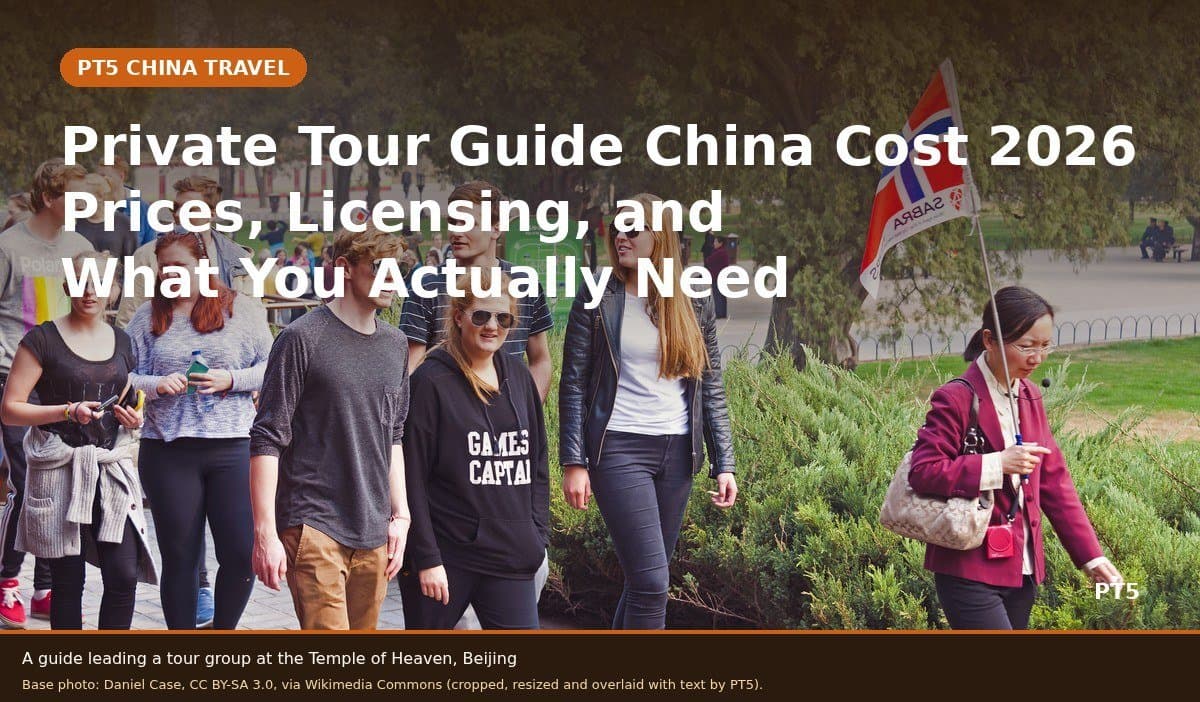
A licensed private guide in China costs about ¥600-1,500 (about US$90-225) a day in the big cities, and the fee only covers guiding and translation: tickets, meals, transport, overtime and a tip are extra. This guide sets out the 2026 price bands by city tier and language, what the daily fee does and does not include, how to verify a guide’s license on the national platform in under a minute, where to book safely, the one place tipping is expected, and what a trip actually needs beyond narration.
Good help changes a China trip more than almost anything else you can buy. It is not just the language. It is the ability to walk past the ticket queue, read a temple hall the way a local reads it, order the right dish from a menu with no pictures, and handle the small frictions (ticket apps, passport checks, taxi meters) that eat a foreigner’s day [1][3][6].
Before you compare prices, ask the question that matters first: what do you actually need on this trip? A scripted narration at every sight, or someone who makes the whole day work, from payments and tickets to a pharmacy run at nine at night? Traditional guiding grew up around tour groups and entry tickets: a licensed guide sells narration by the day, and the extras (tickets, meals, transport, tips) are priced separately. That model has a coverage problem, because it only touches the sights, and a cost problem, because the daily fee plus extras adds up fast and is easy to compare badly.
This guide answers both sides with 2026 prices from real sources: per-day guide fees across city tiers, what the fee covers and what it does not, a five-minute license check, booking channels that protect you, and the tipping norms that apply specifically to guides and drivers. Then it looks at what tourists actually need, why the traditional guide model struggles to cover it, and how a new kind of service, PT5’s travel companion model, prices itself differently, by service rather than by the day of narration.
What a private tour guide in China actually costs in 2026: daily prices by city tier and language, what the fee includes, how to verify a license, where to book safely, and the one tipping rule that applies.

Quick facts first
- A private English-speaking guide in a major Chinese city typically costs ¥600–1,500 (about US$90-225) per day, depending on city tier, language and service depth [2][3][4].
- Budget cities sit lower: roughly ¥400–700 (about US$60-105) a day for a private guide in many second- and third-tier cities [3][4].
- A full-day private guide in Beijing or Shanghai with driver and vehicle runs ¥800–1,500 (about US$120-225) for guide plus car [3][6].
- Forbidden City one-on-one deep-dive guiding costs about ¥1,500–2,200 (about US$225-330) for 6 hours in 2026, with peak-season prices up 20–30% [6].
- The fee usually covers guiding time and translation; entrance tickets, meals and transport are typically extra unless stated [1][2][6].
- China requires guides to hold a government-issued license (daoyou zheng, the tour guide license); you can verify any guide online in under a minute [8][9][10].
- Tipping is not part of everyday Chinese culture: the one clear exception is private guides and drivers on tours, where ¥100–200 (about US$15-30) a day per group for a guide is the common range [5][14][16].
- Never pay the full fee in advance: a deposit of 20–30% is the industry norm for direct hires [12].
1. What a private guide actually costs
There is no single “price of a guide in China”: the fee moves with the city, the language, the length of the day and how deep the guiding goes. The practical way to think about it is by city tier and service type [2][4].
By city tier
Wanderpeng, a custom-tour operator with 15 years of on-the-ground pricing across 35 Chinese cities, puts a private English-speaking guide at ¥600–1,500 (about US$90-225) per day depending on the city, with a private driver and vehicle at ¥500–1,200 (about US$75-180) a day [2]. The same source ranks Beijing, Shanghai, Xi’an, Chengdu, Guangzhou, Shenzhen, Nanjing and Hangzhou as tier-1 pricing cities, where a full custom tour with guide, driver and arrangements lands around ¥1,500–3,500 (about US$225-525) per person per day; tier-2 cities such as Suzhou, Guilin, Xiamen, Chongqing and Kunming run ¥1,000–2,500 (about US$150-375); tier-3 cities such as Pingyao and Shaoxing run ¥800–1,800 (about US$120-270) [2].
Go2-China, a long-running China travel agency, quotes private guides at ¥400–700 (about US$60-105) a day and guide-plus-driver packages at ¥800–1,500 (about US$120-225) a day, and notes that private tours typically cost two to three times a group tour, a premium paid for flexibility, personal pacing and zero shopping stops [3].
A 2026 Chinese-language guide to hiring local tour companions (dipai, the local-guide market) frames the same market in three bands: a cost floor around ¥400–500 (about US$60-75) a day (below which you should worry about shopping kickbacks), the mainstream working rate of ¥600–800 (about US$90-120) a day in most cities, and a brand tier of ¥900–1,500 (about US$135-225) a day for guides with dozens of photographed reviews [4]. First-tier cities and licensed guides with vehicles price higher across all three bands [4].
By language and depth
Language shifts the top of the range rather than the bottom. On one Shanghai operator’s published list, an 8-hour English-speaking guide runs ¥800-950 (about US$120-145) for one or two travelers, while German or French runs ¥1,000 (about US$150) [13]. Specialists, licensed guides with history or archaeology backgrounds or museum docents, command the top of the range; a senior Forbidden City explainer can cost ¥300–500 (about US$45-75) a day more than a junior licensed guide [6].
The Forbidden City example
The Forbidden City is China’s single most-visited sight, and the Palace Museum caps daily admissions; in peak season tickets are often gone a week ahead [6].
A one-on-one deep-dive guided tour of the palace runs about ¥1,500–2,200 (about US$225-330) for 6 hours in 2026; a 3-hour focused explanation runs about ¥800–1,200 (about US$120-180); family groups of 2–6 people pay roughly ¥1,200–1,800 (about US$180-270) per group for a 4–6 hour tour; and a 7–15 person small group drops to about ¥200–350 (about US$30-55) per person [6]. Licensed private half-day Forbidden City tours from Western-facing operators land around ¥800–2,000 (about US$120-300) per group, usually on top of the ¥60 (about US$9) peak-season entry ticket (¥40, about US$6, from November to March) [6][7]. Peak dates (May Day, National Day, July–August) can push prices up 20–30% [6].

2. What the fee includes (and what it does not)
Before comparing quotes, know what the daily fee typically covers and where the extras start. A professional private guide’s day generally includes [1][2][3]:
- Guiding time and live translation: the core service;
- Route planning and itinerary adjustment during the day;
- Ticket-booking assistance (many major sites require online booking with passport details);
- Restaurant recommendations and, often, table bookings;
- Navigation through queues, metro systems and station procedures.
What is usually not included, unless the quote says otherwise [1][2][6]:
- Entrance tickets (admission is charged separately almost everywhere);
- Meals for you or the guide (many guides ask you to cover their meal or add it to the quote, so ask in advance);
- Transport and the guide’s transport costs;
- Overtime beyond the agreed hours (Trips to Shanghai lists extra hours at ¥100 (about US$15) per hour) [13].
The single most useful question to ask before booking: “What exactly is included in this price?” A good guide answers with a list; a vague answer is a warning sign [1][2].
3. How to check a guide is licensed
China regulates tour guiding by law: anyone who guides for pay must hold a government-issued tour guide license (daoyou zheng), which combines a national qualification certificate with an electronic license card [8][9]. Guides are licensed for specific languages, and the license is renewable every three years [9].
Unlicensed “black guides” (hei daoyou) operate illegally and are the main source of forced shopping, fabricated history and zero legal recourse when something goes wrong [9][10][10].
The three-step check
Ask for the license. Every licensed guide carries a plastic ID-style card with a photo, license number, guiding language and validity date [9][10]. A professional presents it happily; excuses, delays or “I don’t need one” mean walk away [9].
Verify it online. China runs an official national tourism supervision platform (quanguo lvyou jianguan fuwu pingtai) where anyone can search a guide by license number or phone number [8][10][11]. In a browser visit the platform’s guide-search page (mr.mct.gov.cn), or on WeChat search the “Quanguo Lvyou Jianguan Fuwu” mini-program, tap the guide-query entry and enter the guide’s details [8][11]. A green electronic license that matches the guide’s ID is good; “no result” or “invalid” means the license is expired, canceled or fake: exclude the guide [10][11].
Check the contract and payment terms. Licensed guides work under a tourism contract that states no forced shopping and lists costs up front [10]. For direct hires, the industry norm is a deposit of 20–30% via Alipay or WeChat Pay, with the balance paid after the tour [12]. Never pay the full amount in advance, and be suspicious of anyone who routes the entire payment through an opaque middleman [12].
The same platform the government uses is open to you: the Ministry of Culture and Tourism’s guide database is public, free and in Chinese, and the QR code on the electronic license scans straight into it [8][11].

4. Where to book a guide safely
Booking channels fall into three tiers of safety and cost [3][12].
OTA International platforms and OTAs
Viator, GetYourGuide, Klook and similar platforms list vetted guides with traveler reviews, and cancellation terms vary by operator [1]. Prices tend to include platform markup, and quality varies by operator, so read reviews for specifics, not superlatives [1]. Ctrip is the Chinese platform with the largest review base, including feedback from international travelers, and sits between convenience and transparency [12].
Hotels and established agencies
International hotels in Beijing and Shanghai keep curated lists of English-speaking guides they trust, often the most reliable route for last-minute bookings [1]. Long-established agencies such as China Highlights and Intrepid Travel employ experienced, licensed guides and handle multi-city logistics [1][3]. The trade-off is price: agencies typically add 50–100% on top of a direct hire for the coordination they provide [12].
Direct hire (most cost-effective, requires vetting)
Hiring a guide directly through WeChat or local platforms cuts the middleman and often gets you a better guide for less money [12]. It also puts the vetting work on you: verify the license (Section 3), read verified reviews, confirm whether the guide’s meals and tickets are included, and agree the fee and deposit terms in writing before the tour [12].
5. Tipping in China: the one place it applies
China is not a tipping culture. In restaurants, taxis, shops and most hotels, the price you see is the full price; leaving money on the table confuses staff, who may chase you out to return it [5][14][15]. Mobile payment apps do not even have a tip field [5].
The one clear exception is private tour guides and drivers. Because the tourism industry has absorbed international expectations, tipping a private guide and driver on a tour is standard practice [5][14][16]. Common ranges:
| Who | Common tip in 2026 | How it works |
|---|---|---|
| Private guide (full day) | ¥100-200 (about US$15-30) per group per day | Cash, at the end of the day [5][15][16] |
| Private driver (full day) | ¥50-100 (about US$8-15) per group per day | Cash, at the end of the day [5][15] |
| Group tour guide | ¥30-50 (about US$5-8) per person per day | Often collected centrally; ask whether it is already included [14] |
Hand the tip in cash, ideally in an envelope or red packet (hongbao) given with both hands at the very end of the tour, a gesture of respect that guides genuinely appreciate [16]. If service was poor, you are under no obligation; a tip is a thank-you, not a fee [5][14]. And if a tour company tells you tips are “mandatory” mid-tour, that is a red flag [5]. PT5 takes the same line: our agents do not accept tips at all, so the price you agree is the price you pay.
6. FAQ: hiring a guide in China, answered
Q: How much is a private tour guide in China per day?
In major cities, roughly ¥600–1,500 (about US$90-225) a day for a private English-speaking guide; budget cities sit at ¥400–700 (about US$60-105); guide plus driver runs ¥800–1,500 (about US$120-225) [2][3][4].
Q: Is tipping expected in China?
Not in everyday life: restaurants, taxis and shops expect the exact price and nothing more. The exception is private tour guides and drivers, where ¥100–200 (about US$15-30) a day per group for a guide is the common range [5][14][15].
Q: How do I know my guide is licensed?
Ask for the license card, then verify the number on the official national tourism platform (mr.mct.gov.cn) or the WeChat “Quanguo Lvyou Jianguan Fuwu” mini-program. No result means no valid license [8][10][11].
Q: Should I pay a deposit?
Yes, 20–30% via Alipay or WeChat Pay is the industry norm for direct hires. Never pay the full amount in advance [12].
Q: Are entrance tickets included in the guide fee?
Almost never. Tickets, meals and transport are usually extra unless the quote says otherwise [1][2][6].
Q: Can I book a guide in English at the Forbidden City?
Yes, licensed English-speaking guides operate there daily, and private one-on-one deep dives run about ¥1,500–2,200 (about US$225-330) for 6 hours in peak pricing [6]. Book ahead; the palace sells out in advance [6].
7. Your hiring checklist
- Decide the service type: site guiding, full-day guide, or practical companion support.
- Set a realistic budget using the city-tier ranges in Section 1.
- Shortlist guides on a platform with verifiable reviews (Ctrip, Viator, hotel list, or a direct referral).
- Ask for the license card and verify the number on the national platform.
- Confirm in writing what the fee includes: tickets, meals, transport, overtime.
- Agree payment terms: 20–30% deposit, balance after the tour.
- Ask how the guide handles a disrupted day (closed site, rain, train change).
- Plan tipping: cash in an envelope, ¥100–200 (about US$15-30) a day per group for a private guide.
- For a multi-city trip, decide whether you want one companion across cities plus local guides at each stop.
8. Traditional guides vs PT5: what tourists actually need
Traditional guiding is built around sights and tour groups: entry tickets, fixed routes, a script at each stop. That covers part of a trip, but only part. Many visitors want the rest of China as well: real daily life, unscripted human contact, shopping the way locals shop, and the freedom to keep their own pace and privacy.
The traditional guide model: what it is good at, and where it struggles
A licensed guide is the right choice when you want expert historical and cultural interpretation, or when a site’s rules and queues are the main challenge [1][6]. But the model carries four structural frictions for a visitor:
It sells narration by the day, and the extras are priced separately. A guide day is sold in half-day or full-day blocks and covers guiding and translation; tickets, meals, transport and overtime are almost always extra [1][2][6]. Two visitors can book the same-looking guide and pay very different totals depending on what they add on.
Deposits and peak-season surcharges come first. Direct hires typically ask for a 20–30% deposit in advance, and peak dates (May Day, National Day, July–August) can push prices up 20–30% [6][12].
Licensing is real, but verification is on you. Unlicensed “black guides” are the main source of forced shopping, fabricated history and zero legal recourse when something goes wrong. You can verify any guide online in under a minute, but only if you know to ask [9][10][10].
Tipping is expected in this one corner. China is not a tipping culture, but private guides and drivers are the exception: ¥100–200 (about US$15-30) a day per group for a guide is the common range [5][14][16].
None of this means guides are bad value. It means the traditional model is optimised for sightseeing, and sightseeing is only part of what a trip needs.
What tourists actually need
Ask a visitor what made their China trip hard, and the answer is rarely “I needed more narration”. It is the payment counter that only takes a Chinese app, the address a driver cannot read, the ticket app that rejects a foreign passport, a parcel that needs packing and shipping, a pharmacy run at nine at night. Those are the problems that decide whether a trip feels easy or exhausting, and the traditional guide day does not cover them, because they happen outside the sights.
How the two pricing models compare
| Traditional licensed guide | PT5 remote companion | PT5 in-person companion | |
|---|---|---|---|
| What you pay for | Narration and translation, sold by the half-day or the full day | Help by message: a time window, an hour, or a set of days | A person beside you, priced by the hour or by the day |
| Who you travel with | Usually a group tour; a private tour costs two to three times as much [3] | One-to-one: your own group only, up to four people | One-to-one: your own group only, up to four people |
| Shortest booking | Half a day or a full day | From 30 minutes | From 1 hour |
| Lowest price | ¥600-1,500 (about US$90-225) a day [2][3][4] | From US$10 for 30 minutes | From US$50 for one hour (VIP US$35) |
| Comparable full day | A guide day is 8 hours: ¥600-1,500 (about US$90-225) [2][3][4] | 10-hour Arrival Day: US$150 (VIP US$100) | 10-hour pack: US$300 (VIP US$210) |
| What the price covers | Guiding and translation; tickets, meals and transport are extra | Practical support by message, with a written quote before you commit | Hands-on help in person, with a written quote before you commit |
| Extras to watch for | Tickets, meals, transport, overtime, peak-season surcharge, tips | Nothing beyond the written quote, and no tips | Nothing beyond the written quote, and no tips |
| Deposit | 20-30% before the tour, the industry norm [12] | Set out in the written quote; no opaque middleman | Set out in the written quote; no opaque middleman |
| Where the income comes from | Narration fee; unlicensed guides add shopping kickbacks | Service fee only, unrelated to the shops you walk into | Service fee only, unrelated to the shops you walk into |
| Best for | History, culture, museums and deep sightseeing [1][6] | First visits, families, the day-to-day logistics in your phone | Market runs, banks, a day that needs a translator |
A licensed site guide and a PT5 companion can sit on the same itinerary, and for most trips that is the strongest combination: the guide explains the palace, and we handle the practical layer around it.
How PT5 prices itself differently
PT5 is not a guide service. We do not sell sightseeing tours, we do not supply licensed site guides, and we do not run group departures. We charge by service, not by the day of narration. Remote support is sold as a time window, an hour or a set of days. In-person companionship is priced by the hour or by the day, so you can book a single afternoon or a full week. Buying on your behalf is a service fee calculated on what you buy, charged openly on the purchase value rather than hidden inside it. Deliveries are priced by delivery point, with the waiting time included and an overtime rate beyond it. Emergency advances are settled with you in RMB before you leave. You pay us for the service: no part of our income depends on which shop you walk into.
PT5 is a practical travel companion for individual travelers and small groups of up to four. Our team supports trips anywhere in China, in seven practical ways.
- Planning before you fly. Tell us your dates, budget and interests, and we suggest an itinerary that fits your pace, with neutral advice from people who live here, and answer the practical questions a first trip always raises.
- Day-one problems, solved. We arrange an eSIM or a Chinese number and sort WeChat verification, so payments and messages work from the moment you land.
- Two ways to have a person with you. Remote support: message us for language, payment, directions, menus and last-minute changes, and we appear from your phone only when you need us. In person: a local companion in your city for the hours or days when you want someone beside you, whether that is a market run, a bank or a day that needs a translator.
- Local in every city, backed by a national team. Every city we cover has its own PT5 local person, who can move to you quickly when something urgent happens. Behind that person sits a team that handles suppliers, bookings and logistics across the country.
- A shopping assistant. We compare prices, buy online or in the market, receive the goods, run quality checks, handle returns, and pack, repack or ship whatever will not fit in your baggage.
- Emergency small payments. When a shop only takes a personal payment code or your phone fails at the wrong moment, we can advance a small amount in RMB and settle it with you before you leave.
- Transparent process and pricing, and no tips. You get a written quote before you commit, and every fee is explained before anything is ordered or booked. None of our agents accepts tips: the fee you agree is the whole amount, and nobody is waiting for an envelope at the end of the day.

Message us on WhatsApp with your dates and cities.
The Short Version
A guide is worth paying for in China, but the fee only works in your favor when you know what it covers and who you are paying. Compare quotes on inclusions first, verify the license number on the national platform before you send any deposit, and treat the tip as a thank-you at the end of the day rather than a charge you owe everywhere else. If what you actually need is the practical layer of the trip, a licensed site guide and a PT5 companion can sit on the same itinerary.
Sources
[1] Tour Guides in China – “Tour Guides in China” – https://tour-guide.com/china/
[2] Wanderpeng – “China Custom Tour Cost 2026: Complete 35-City Price Comparison” – https://wanderpeng.com/en/blog/china-custom-tour-cost-comparison-35-cities
[3] Go2-China – “China Tours and Day Trips: What Is Worth It” – https://go2-china.com/blog/china-tours-day-trips-worth-it/
[4] Toutiao / Xunyou Xiaoyao – “How to find a local tour companion without stepping on traps: 5 things to understand in 2026” – http://m.toutiao.com/group/7683782779351417371/
[5] Ways China – “Tipping Culture in China” – https://wayschina.com/en/articles/tipping-culture-in-china
[6] Cncn.com – “2026 Forbidden City private guide booking reference: route planning and cost notes” – https://m.cncn.net/blog/1402062
[7] Ways China – “Luxury Travel Guide to Beijing” – https://wayschina.com/en/articles/luxury-travel-guide-to-beijing
[8] Fujian Provincial Government portal – “Tour guide license procedures” – https://www.fj.gov.cn/nrrh/swlt/202509/t20250916_7010347.htm
[9] Travel China With Me – “Decoding the China Tour Guide License” – https://travelchinawith.me/china-facts/china-tour-guide-license/
[10] NetEase News – “2026 Yunnan National Day Erhai guide recommendations: 3 licensed guides and avoidance tips” – http://m.163.com/dy/article/L6SCLMPR0556MKKZ.html
[11] Daoyou Home – “How to verify a tour guide license: authenticity check methods” – https://www.daoyouhome.com/ichelp/267.html
[12] Hi-China – “How to hire a local guide for China travel?” – https://hi-china.com/d/732-how-to-hire-a-local-guide-for-china-travel
[13] Trips to Shanghai – “Explore Shanghai with a Professional Private Guide” – https://www.tripstoshanghai.com/tours/show/shanghai-private-tour-guide.htm
[14] China Trip Box – “Tipping in China 2026: When to Tip and When Not To” – https://www.chinatripbox.com/posts/tipping-in-china-when-it-s-expected-and-when-it-s-not/
[15] China Navigators – “Tipping in China: Why You Should (Usually) Avoid It” – https://www.chinavigators.com/tipping-in-china/
[16] Into Travel China – “Should I Tip in China? The 2026 Reality for Travelers” – https://intotravelchina.com/articles/1782375770615156309.html
 Chat on WhatsApp
Travel notes & questions
Conversation
Loading the conversation…
Want to join in? Sign in to your PT5 China account.